
Where OT Network Design Meets Reality
Practical Guide for Manufacturing Oil & Gas and Utilities
April 27, 2026
Most network problems in industrial environments don't start with bad intentions. They start with a reasonable decision made under pressure—a vendor needed access, a new line got added, a switch got installed to solve an immediate problem—and nobody had the time or the full picture to think through what it would mean six months later.
That's the gap between network design and implementation: not a single failure point, but the build up of reasonable-seeming decisions that weren’t connected into a bigger picture. Our job at INS is to help you close that gap. Instead of ignoring operational constraints, we work within them.
This guide is designed to take OT network design from concept into execution. It covers the implementation patterns that matter in industrial environments, where projects actually break down, and what “good” looks like when the work is done.
What "Implementation" Really Means for OT Networks
The biggest misconception about OT network implementation is that it ends once everything is plugged in. Take it from us: it doesn't.
The networks that hold up across equipment additions, vendor changes, workforce transitions, and operational expansions are the ones that were built with the full lifecycle in mind. That means design decisions informed by how the network will be operated and maintained, not just how it will be configured at commissioning. It means documentation that reflects reality, not original intent. And it means governance structures that keep the architecture from decaying back into the patterns it was meant to replace.
Implementation is also always constrained by reality that no wireframe fully captures. Outage windows are shorter than anyone wants. Some areas require hot work permits before any physical work can happen. Hazardous area classifications limit what equipment can be installed where. Legacy systems that are still running critical processes can't simply be taken offline for an upgrade. Sites that look identical on a network diagram are different in ways that only become obvious once someone is standing in front of the hardware.
The practical response to that reality isn't to lower the bar. It's to phase the work strategically.
Step-by-Step OT Network Implementation
Across environments and sectors, the implementation approach that holds up consistently follows the same underlying logic.
Step 1: Define what can’t fail.
Identify the process-critical systems and the failure domains that must be protected. Understanding what can never cascade shapes every segmentation decision, redundancy choice, and priority call that follows. Everything else is built around this.
Step 2: Map how data actually moves, not just where devices are connected.
Topology diagrams show physical relationships. They don't show who's talking to whom, how often, what the traffic looks like under load, or which communication paths are load-bearing for production. You need both pictures. In most environments, only one exists, and it's often out of date.
Step 3: Choose patterns that fit the actual site.
Topology, redundancy model, segmentation structure, remote access design—these have to account for the physical environment, the operational realities, and what the team that inherits the network can realistically support. A design that requires expertise the site team doesn't have isn't a good design for that site, regardless of how sound it is technically.
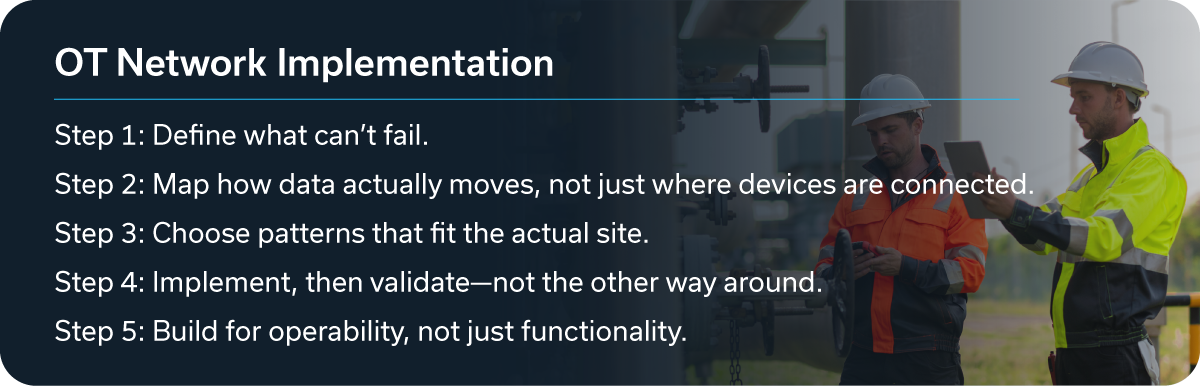
Step 4: Implement, then validate—not the other way around.
Configuration is not validation. Failover drills, traffic baseline captures, and testing under realistic load conditions give you documented evidence of how the network behaves. That documentation becomes the reference point when something changes, or when something breaks and you need to understand what "normal" looked like before it happened.
Step 5: Build for operability, not just functionality.
Change control, monitoring, and clear ownership don't make the shortlist when projects run long. They're also what determines whether the work holds up after the project team leaves. A network that works at go-live but has no governance around it will drift, and the drift tends to accelerate.
Building an OT Network for Your Industry
The basic process doesn’t change across sectors, but the environments do.
Manufacturing
Walk into a manufacturing environment and you'll usually find multiple cells and production lines, OEM skids that arrived with their own embedded networks, integrators who needed access during commissioning and never fully left, and a mix of PLC vintages that spans a decade or more. It's a dynamic environment: lines get added, equipment gets upgraded, and the network is expected to absorb all of it without complaint.
Implementing an OT network in a manufacturing facility focuses on a few things:
- segmentation that aligns to production cells and critical process steps
- commissioning patterns that are repeatable across lines and facilities
- structured governance of vendor access
The failure mode that shows up most often isn't dramatic. For example, let’s say a new packaging line gets added, but the network wasn't formally updated to accommodate it. Because nobody flagged the segmentation implications, within just a few months, there's intermittent downtime and broadcast behavior that's hard to pin down because the architecture was never designed to absorb the addition. Nothing is broken in an obvious way. The network just grew past what it was built to handle.
Oil & Gas
Upstream and midstream environments present a different set of constraints. Sites are remote, distances between assets are long, hazardous area classifications restrict equipment choices, and link reliability can vary significantly based on environmental conditions. When something goes wrong at a well pad or compressor station, the nearest qualified technician may be hours away.
Implementation in these environments has to account for that reality from the start. Connectivity patterns for remote assets (well pads, compressor stations, pipeline terminals) need to be designed for resilience and remote diagnostics, not just basic connectivity. Boundary control for vendor access matters more here, not less, because the consequence of an unmanaged remote pathway in an unmanned facility is significant. Redundancy has to be designed with realistic failover behavior, not just redundant links that haven't been tested.
The failure pattern that recurs in O&G often looks like this: a remote compressor station with intermittent link instability and vendor remote access that was set up quickly and never formalized. When an unplanned trip occurs, diagnosis takes far longer than it should—because nobody has a clear current picture of what's connected, who has access, or what normal looked like before the event. Every troubleshooting session starts from scratch.
Energy & Utilities
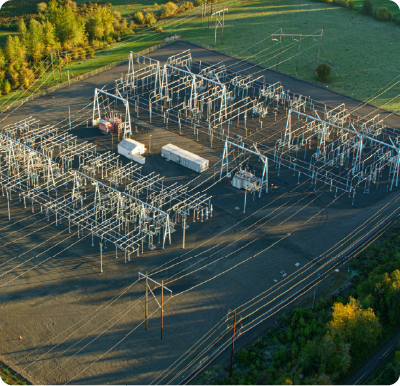
Utilities operate under a different kind of pressure. Regulatory oversight creates compliance requirements that make auditability part of the architecture, not a reporting exercise. The consequence of an outage is high. Asset lifecycles are long. And in water, wastewater, and power distribution environments, facilities are often geographically distributed in ways that make consistent network behavior across sites difficult to maintain.
Your network architecture needs to support control and auditability. That looks like being able to demonstrate, not just claim, that segmentation exists, access is governed, and the network is configured and maintained to support its intended operational objectives. Standardized site patterns make multi-site management tractable, and remote monitoring actually reflects what's happening at the site level, not just whether the uplink is alive.
Here’s where we most often see networks in this industry fail:
- centralized monitoring that technically functions, but there’s network behavior at individual lift stations or substations that nobody can fully characterize
- diagrams existed once but no longer reflect what's installed
- inherited networks with unclear ownership and security tooling layered on top of architecture that was never structured to support it
When an incident occurs, the investigation reveals that the network was never as well understood as it appeared to be.
 |
 |
 |
Where OT Networking Projects Break Down
Some problems don't belong to any one sector. They show up everywhere, and they're responsible for more failed implementations than any technical decision.
Vendors and OEMs bring their own networks. OEM skids and packaged control systems often arrive on-site with switches pre-configured and remote access already established, under the vendor's terms, not yours. Integrators connect during commissioning and quietly maintain that access long after the project closes. If you haven't defined what's acceptable before the equipment arrives, you've already lost the argument. Network access permissions, credential standards, and remote access structure belong in the procurement spec, not the post-mortem.
Legacy systems become permanent unknowns. Every industrial environment has them: systems running critical processes that nobody wants to touch. That's fine. The problem isn't the age of the equipment. It's when those systems become boundary-less and undocumented, woven into the architecture without anyone knowing exactly how. Isolate them, document them, and plan phased upgrades that respect operational windows. A legacy system with clear boundaries is manageable. One that's loosely connected to everything and poorly understood is a liability.
Standardization breaks down at the edges. Multi-site organizations almost always struggle with this. The instinct is to standardize everything, until local realities start creating exceptions, and the exceptions become the norm. Naming conventions, segmentation models, and remote access patterns should be consistent. Media choices, physical topology, and environmental accommodations need to flex. Know which category you're in before you make the call, or you'll end up re-making it under worse conditions.
Nobody owns it after go-live. This is where more projects quietly unravel than anyone wants to admit. IT, controls engineering, OT operations, vendors—everyone has a stake, and when ownership boundaries are fuzzy, maintenance falls into the gaps. Monitoring alerts don't get acted on. Change control gets bypassed because it's unclear who approves what. Documentation drifts. Define ownership explicitly before handoff, with specific escalation paths. A network without a clear owner isn't maintained, it's just used until something breaks.
What "Finished" Actually Looks Like
Implementation is done when the people who will own the network can operate and maintain it, not just the team that built it. That requires specific outputs. These are too often the first things cut when a project runs long, and they're the reason the work doesn't hold.
- Current-state and target-state architecture diagrams (physical and logical) that reflect how the network was actually built and handed off.
- A zone and conduit map with documented access pathways. Who can reach what should be defined and verifiable, not assumed.
- A traffic baseline that captures what normal looks like: volumes, top talkers, broadcast behavior, inter-zone communication patterns. Without it, nothing is comparable when something changes.
- Documented failover test results with recovery expectations. Redundancy that hasn't been tested isn't redundancy, it's a guess.
- Standards documentation covering naming conventions, segmentation rules, remote access policy, and change control. Written for the people who will maintain the network long after the project is closed.
- A defined ownership model with escalation paths. Every segment, every access pathway, every monitoring alert needs someone responsible for it. Gaps in ownership become gaps in everything else.
FAQs
How do you standardize architecture across multiple plants or sites?
Decide what needs to be consistent (segmentation model, naming conventions, remote access design) and what has to flex for local conditions. Apply the standard at commissioning for new sites and phase it into existing ones as maintenance windows open up. It only holds if it's documented and someone is accountable for maintaining it.
How do you handle OEM and vendor skids without losing architectural control?
Define the requirements before the equipment arrives—in the procurement spec, not during startup. Once a skid is running production under vendor-defined terms, getting control back is a much harder conversation.
What's the safest way to modernize a brownfield OT network?
Phase it, and start with the highest-risk gaps. Contain first, normalize remote access second, then work toward redundancy and standardization. Align everything with available maintenance windows. Trying to do it all at once is how you create the disruptions you're trying to fix.
What should we require from integrators at commissioning?
Accurate as-built documentation, a traffic baseline, documented failover test results, and a clean handoff of any credentials or access used during the project. Put it in the contract. Integrators who push back on committing to those outputs before work starts are telling you something worth knowing early.
Start With a Network Assessment
If the environment is multi-site, vendor-heavy, or running without current documentation, the implementation work has to start with understanding what actually exists. You can't build a phased improvement plan around an architecture you can't fully describe.
The same is true when recurring uptime issues don't have clear root causes, when modernization is on the roadmap and disruption risk is real, or when remote access has grown without any structured model governing it. An assessment in those situations isn't a delay. It's what makes the rest of the work possible.
INS conducts structured OT network assessments that provide a clear current-state picture, surface where the real risks are, and help define a phased path forward that works within your operational realities.