How a Leading Midstream Energy Company Unified 33,000 Miles of Pipeline Data—and Saved $100K in the Process

33,000 miles of pipeline.
Hundreds of sites.
Thousands of devices.
None of it speaking the same language.
As this midstream energy company grew, so did the complexity behind its operations. Different protocols, different systems, and different ways of capturing data, all layered on over time.
The result wasn’t a lack of information. It was a lack of alignment.
Without that alignment, getting a real-time, reliable picture of what was happening across the network was harder than it should’ve been.
The Real Risk Wasn’t Downtime—It Was Delay
In pipeline operations, timing is everything. If something shifts (flow rates, pressure, chemical composition), you need to know immediately.
Without real-time visibility, small issues can quietly turn into expensive ones. A bad mixture entering the pipeline. Equipment beginning to degrade. Conditions drifting outside acceptable ranges.
The costs of those problems can add up quickly, from shutdowns and cleanouts to repairs and lost time. This customer knew that if they could see what was happening at the edge in real time, they could better prevent those outcomes.
But to do that, they first had to solve the bigger issue: How do you take a fragmented, multi-protocol environment and turn it into a single, reliable stream of usable data?
Unifying the Edge Without Rebuilding Everything
Rather than rip and replace existing systems, the goal was to create a layer that could bring everything together. The answer was a unified edge solution that could sit across different environments, ingest multiple protocols, and standardize the data before sending it to the cloud.
Working alongside the customer, INS designed a solution that did exactly that.
At the center was a Moxa hardware platform capable of handling the demands of the field—providing the compute power, memory, and connectivity needed to operate reliably in remote and often extreme environments. Just as importantly, it allowed the customer to consolidate multiple pieces of hardware into a single, more efficient footprint.
But the real transformation happened at the data level.
The system was built to take in various protocols at the edge, convert them into MQTT, and transmit them into the cloud in a consistent, structured format. For the first time, the company had a unified data pipeline that could support real-time visibility and faster decision-making across the organization.
Built for the Long Haul, Not Just the First Deployment
Solving the immediate problem wasn’t enough. This solution needed to last.
Because the company operates in a regulated environment, alignment with its security and maintainability requirements was non-negotiable. Systems needed to be patched remotely. Updates needed to be controlled. And the architecture needed to support evolving applications over time.
INS built the platform on a long-term operating system that enabled support for containerized applications, giving this customer the flexibility to deploy and manage software at the edge without overhauling the entire system. Updates could be pushed remotely, the platform could support the customer’s approach to maintaining security, and new use cases could be introduced without starting from scratch.
Execution at Scale Is Where Most Projects Break—Not This One
Designing a solution is one thing. Deploying it across thousands of miles of pipeline is something else entirely.
From the beginning, our customer needed a partner who could handle more than just technology. They needed someone who could manage logistics, provisioning, and deployment at scale, without slowing down the business.
INS approached the project through a full lifecycle model, guiding the customer from initial discovery through development, delivery, and deployment.
That meant:
- Helping identify the right hardware and architecture early on
- Supporting testing and validation with engineering expertise
- Pre-configuring and provisioning devices before they ever reached the field
- Managing logistics to ensure consistent, reliable rollout across locations
Instead of overwhelming internal teams with deployment complexity, INS delivered systems that were ready to perform the moment they arrived.
Success Created a New Challenge—And a Bigger Opportunity
As the solution proved itself, adoption spread. More teams across the organization began to see the value of having standardized data and reliable edge infrastructure. More use cases emerged. More applications were deployed.
And with that growth came a new layer of complexity.
Now the challenge wasn’t just connecting devices, but managing them. Without a centralized way to monitor and manage everything, the system risked becoming fragmented all over again.
From Connected Devices to a Fully Managed Ecosystem
INS didn’t stop at deployment.
Working alongside the customer, our team designed and developed a custom fleet management platform that brought the entire edge environment into view.
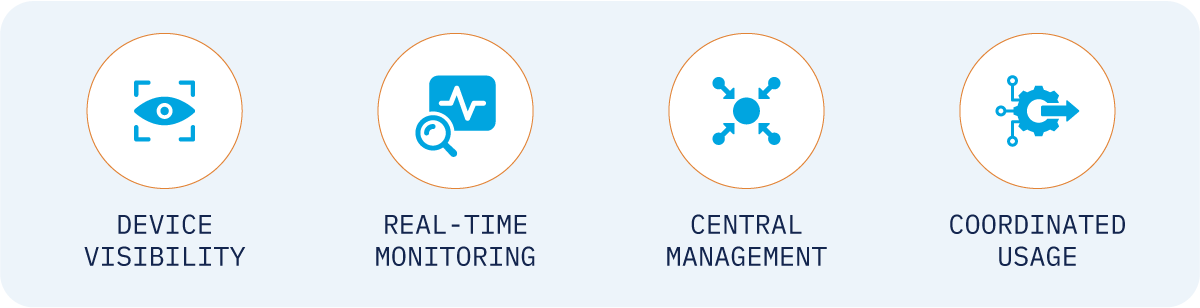
For the first time, the company could:
- See all of their edge devices across the network
- Monitor performance and status in real time
- Manage firmware, customer-directed security updates, and applications centrally
- Coordinate usage across multiple departments
What had once been a distributed, difficult-to-manage system became a cohesive, controlled ecosystem.
The Outcome: Measurable Savings, Operational Confidence, and Room to Grow
With a unified architecture in place and full visibility across their edge environment, the impact was immediate.
Operations became more efficient. Risks were reduced. Decision-making improved.
This customer reported over $100,000 in savings, driven by better visibility, faster response times, and reduced operational disruption. But more importantly, they now had a foundation they could build on.
- A system that could scale with the business.
- A platform that could support new applications.
- And a partner that understood how to evolve alongside them.
This story wasn’t just about hardware, or software, or data. It was about turning complexity into clarity. And when you’re working across 33,000 miles of pipeline, that clarity changes everything.