Fleet of Vision: Keeping a Mobile Security Camera Network in Frame
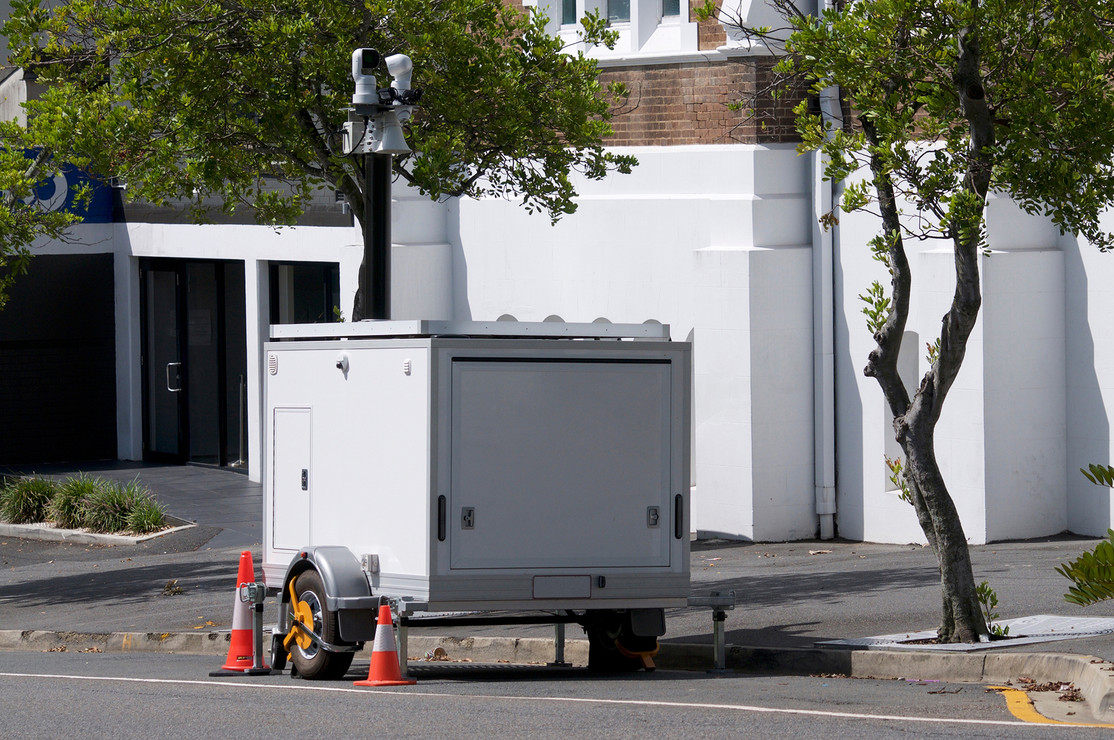
A leading national security services provider built its reputation on staffed, on-site protection. But as demand for coverage grew, staffing every location around the clock stopped being scalable on its own. To extend coverage without extending headcount indefinitely, the company began deploying a nationwide fleet of remote security camera trailers — self-contained units that can be dropped into a parking lot, a jobsite, or any property that needs eyes on it, with no existing internet or electrical infrastructure required.
That decision presents a challenge: a trailer parked in a lot the client doesn’t own has no Ethernet run, no fiber drop, and often no consistent power. At the same time, it needs to capture continuous video and push it, reliably, to the client’s cloud platform. That’s the problem the INS team was brought in to solve: not just supplying a router, but engineering the full connectivity solution (hardware, software, and network) around a use case with almost no fixed infrastructure to lean on.
Built for the Field, Backed by FirstNet
The trailers themselves have to survive outdoor deployment, including temperature swings, weather, vibration, and long stretches with no one on-site to intervene if something goes wrong. The INS team specified rugged, purpose-built hardware to handle that environment, then paired it with AT&T FirstNet — the network built for first responders and public safety-grade capacity — for the wireless backhaul.
That choice matters most in the moments a generic cellular plan might fail, whether a busy area with heavy network congestion, a weekend event, or a natural disaster. Because the trailers ride on the FirstNet backbone, the client benefits from priority access relative to everyday consumer traffic, available FirstNet plan options can help address the throttling or data overages that can come with standard cellular service. Video keeps moving, whether the trailer is parked in a quiet lot or the middle of a crowd.
The connectivity layer has also evolved with the client over time — from early 3G deployments through LTE and 5G today — as INS has continually reassessed the fleet’s hardware and network needs alongside their own growth.
The Support Model Built for 24/7 Security
A distributed fleet of unattached, outdoor devices creates an obvious support problem. When something goes down, who fixes it, and how fast? For this customer, that answer has been INS Total CARE and Premium CARE Managed Services. Instead of routing issues through their own IT staff, they have a single point of contact for support across the entire fleet.
This is a very complex solution, and these remote deployments need to be working 24/7. If something goes down, the customer needs someone to call, and INS has been there for them. That ongoing relationship — not just the initial deployment — is what has kept them with INS through multiple hardware and network changes.
As their own technology needs have shifted, INS’s role has too — from installer to long-term connectivity partner.
Ready to talk through connectivity for a distributed fleet, remote site, or mobile deployment?
FAQs
What connectivity challenges come with deploying security equipment on unowned property
No fixed infrastructure — no Ethernet, no guaranteed power — means the network has to be entirely wireless and self-sufficient, while still holding up to outdoor conditions and delivering consistent bandwidth for continuous video.
Why use AT&T FirstNet instead of standard cellular service for security camera trailers?
FirstNet prioritizes public-safety and mission-critical traffic, which reduces the risk of throttling or dropped connectivity during high-usage periods — a meaningful difference for applications like security monitoring, where consistent uptime is the whole point.
How does INS support a large, geographically distributed device fleet after deployment?
Through INS Total Care and Premium Care managed services, which give the client a single point of contact for troubleshooting and support across the entire fleet, rather than requiring their internal IT team to manage it directly.
 |
About the AuthorJeremy Omland, Territory Account Manager Jeremy Omland is a Territory Account Manager for Industrial Networking Solutions. He spent more than a decade at Source Inc. as a Business Development Manager, building relationships between manufacturers and customers. Before INS, he spent time in wireless sales roles at Sprint Nextel and Verizon Wireless, which gives him a long view of how cellular connectivity has evolved from early 3G rollouts to the 5G networks powering today’s distributed device fleets.
|