What is OT Network Design?
A Guide for Industrial Network Operations
March 31, 2026
Operational Technology (OT) networks are the communications backbone of industrial production. They connect controllers to drives, sensors to HMIs, process systems to supervisory platforms. They carry the data that allows physical systems to move, regulate, measure, and respond.
In many facilities, though, the network behind those systems wasn’t intentionally designed. It grew over time: a new machine here, a switch added there, remote access enabled when needed. The network functions, but its limitations and weak points aren’t always clear until performance drops or a failure spreads further than expected.
OT network design involves deliberately engineering that infrastructure for industrial conditions. It considers the physical environment, traffic behavior, fault tolerance, segmentation, and long-term maintainability.
That approach is fundamentally different from enterprise IT networking. Industrial environments operate under different constraints: limited downtime windows, long equipment lifecycles, and systems that depend on predictable communication to control physical processes.
This guide breaks down what OT network design actually involves, what it does not, and the results that a well-designed architecture can unlock.
OT Network Design: A Practical Definition
OT exists to facilitate industrial processes safely, predictably, and continuously. Without production, there is no OT. So, when we talk about OT network design, we’re not just talking about “industrial IT.” We’re instead defining how communication is structured within an industrial environment so that production systems can operate reliably and efficiently.
In practice, that means design decisions go far beyond switch selection or IP addressing. They span multiple layers of the environment and account for how physical systems, network infrastructure, and operational constraints interact.
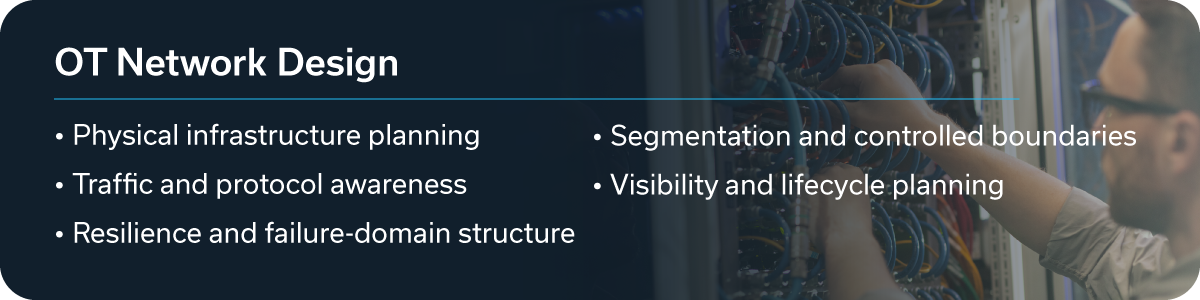
A complete OT network design typically includes:
- Physical infrastructure planning, including media selection, topology, environmental ratings, distance limitations, and equipment class appropriate for plant floors sometimes harsh conditions
- Traffic and protocol awareness to understand how industrial devices communicate, how broadcast or multicast traffic behaves, and how latency or jitter may affect performance
- Resilience and failure-domain structure that define how redundancy works, where boundaries exist, and how failures are contained so that issues don’t escalate
- Segmentation and controlled boundaries to organize the network in a way that aligns with operational risk, access requirements, security and long-term maintainability
- Visibility and lifecycle planning, ensuring the architecture can be monitored, documented, and supported over extended equipment lifecycles
For more details, here’s a guide to best practices for OT network design
What ties these elements together is intent. Each decision influences how the system performs under load, how it responds to change, and how it behaves during disruption.
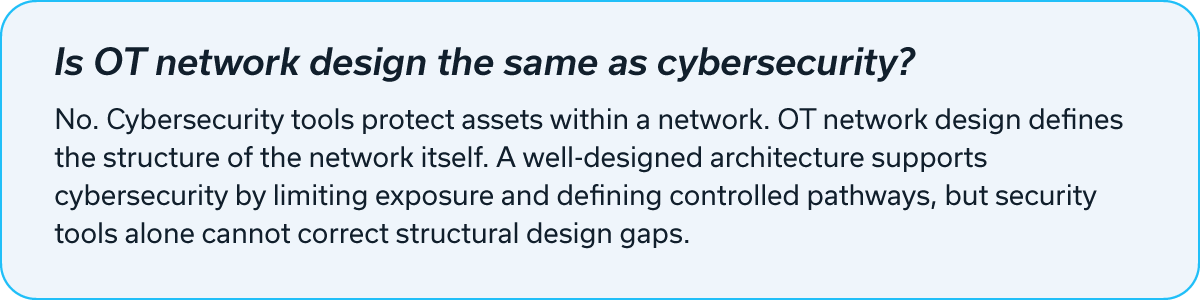
It’s also important to distinguish design from implementation tasks. Purchasing industrial-rated hardware does not, by itself, create architecture. VLAN configuration alone does not establish segmentation strategy. Adding cybersecurity tools to a flat or loosely structured network does not correct foundational design gaps.
OT network design defines structure first, so that performance, resilience, and security are outcomes of the architecture, not afterthoughts layered onto it.
| Your Role Plant Operations Leader |
What Matters Most Uptime, stability, continuity |
How OT Network Design Helps Clear failure domains, structured redundancy, and controlled access pathways reduce likelihood that a single issue disrupts production |
|
Controls/Automation Engineer |
Troubleshooting speed, system predictability, performance | Logical segmentation, traffic control, and documented architecture make it easier to isolate faults, understand behavior, and resolve issues |
| IT / Security Leader | Risk reduction, controlled access, sustainable security posture | Structured segmentation, defined boundaries, and integration to a plant DMZ create enforceable pathways |
Why OT Networks Must Be Designed Differently Than IT
At a surface level, OT and IT networks use similar technologies: Ethernet, TCP/IP, switching, routing. But similarity in tools does not mean similarity in design priorities.
Enterprise IT environments are primarily built around confidentiality, user access, rapid change, and routine maintenance cycles. Systems are refreshed frequently, downtime can often be scheduled, and infrastructure is typically installed in controlled environments.
Industrial environments operate under a different set of constraints, and those differences should shape architectural decisions from the beginning.
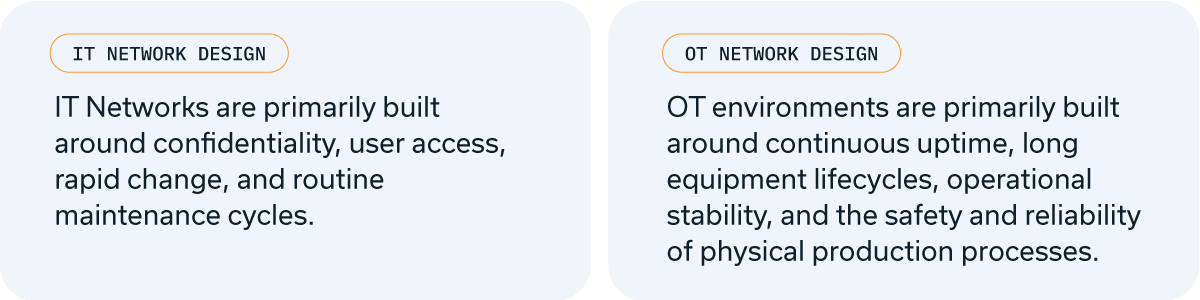
Production systems are expected to run continuously, often with limited maintenance windows. Equipment lifecycles can span decades. Many devices were not designed with modern networking assumptions in mind. Communication supports physical processes, which means instability can have operational or safety implications, not just inconvenience
Applying enterprise assumptions to industrial environments introduces risk, which is why OT network design must account for production realities first.
Engineering for Reliability in OT Networks
Reliability in OT environments is not a single feature or configuration setting. It’s engineered across multiple layers of the network: in how infrastructure is built, how traffic behaves under load, and how failures are contained when they occur.
Each layer influences the others. Ignoring one creates instability in the rest.
Reliability at Rest: The Physical Foundation
In industrial environments, network problems often trace back to physical decisions that were treated as minor details. Choices like cabling type, terminations, distance assumptions, and switch classifications all shape reliability long before traffic or segmentation are discussed
Media selection is not neutral. Copper, fiber, and wireless each behave differently under electrical noise, distance, and environmental stress. Exceeding media limits or ignoring signal loss budgets may not cause immediate failure, but it can introduce intermittent behavior that becomes difficult to isolate later
Environmental conditions also impose constraints that enterprise environments rarely face. Heat, vibration, dust, and electrical interference all affect infrastructure longevity. Installing commercial-grade components on a plant floor can create failure points that do not appear until production is under load.

Installation quality compounds the issue. Improper Ethernet terminations, inconsistent grounding, poorly routed cabling, or non-industrial patch components introduced during expansions can create weak links in otherwise stable systems
Legacy infrastructure adds another layer of complexity. Older cabling that was sufficient for previous data requirements may not support modern bandwidth demands, even if it still appears operational
Physical-layer design is not simply about establishing connectivity. It’s about ensuring that the underlying infrastructure can support predictable communication over time, under real operating conditions.
Reliability Under Load: Traffic Behavior and Network Dynamics
Even when infrastructure is sound, network behavior changes as load increases, which is where many environments are caught off guard
One common surprise is segmentation drift. Devices that were never intended to operate within the OT environment (engineering laptops, vendor tools, temporary gateways) end up sharing the same broadcast domain as mission-critical systems. Bandwidth competition follows. The symptom often shows up as “Why aren’t these devices responding?” even though nothing appears physically broken
Broadcast behavior can also scale in unexpected ways. In loosely segmented networks, plugging in a single misconfigured device can amplify broadcast traffic across large portions of the plant. Without structural boundaries, the impact is not localized, but systemic.

Bandwidth consumption patterns also change over time. So-called “top talkers” can begin consuming disproportionate bandwidth, often without being noticed until performance begins to degrade
Device counts are frequently underestimated. During assessments, it is not uncommon to discover significantly more endpoints than expected, including legacy equipment, temporary installations that became permanent, or undocumented wireless bridges
In some cases, unmanaged Wi-Fi gateways or contractor-installed hardware that provide unintended pathways into the production environment, known as “ghost devices,” are also uncovered
None of these issues are purely traffic problems. They’re structural issues revealed under heavy production loads.
Reliability During Failure: Segmentation and Containment
Failures are inevitable. The question is not whether something will fail, but how far the impact will travel
In flat networks, small issues can escalate quickly. A broadcast problem, a switching loop, or a misbehaving device can disrupt communication across large portions of the plant simply because there are no defined boundaries.

Segmentation changes that dynamic. When systems are grouped intentionally and communication paths are controlled, problems are limited to the area where they originate. Unrelated systems continue operating because they are not sharing the same failure domain
Redundancy plays a role here as well, but only when it is implemented with structure. Adding additional paths without understanding how failover behaves can introduce complexity instead of resilience. Redundancy should reduce impact, not widen it
Containment is a measure of design maturity. In a well-designed OT network, failures are expected, their scope is predictable, and recovery does not require unraveling the entire environment
What Good OT Network Design Enables
Well-designed OT networks make operations more predictable, easier to support, and safer to modernize.
Operational Stability
When architecture is intentional:
- Outages are less likely to cascade beyond their point of origin
- Troubleshooting is faster because boundaries are clear
- Performance is more predictable under load
- Changes can be introduced without unintended side effects
Instead of reacting to unexpected behavior, teams operate within a structure they understand.
Risk Reduction and Incident Containment
Structured segmentation and defined communication paths reduce exposure. If an issue occurs, whether operational or security-related, its scope is limited
Clear access pathways also make remote connectivity more controlled. Rather than multiple unmanaged entry points, access is normalized and governed by design. The result is not just better security posture, but clearer operational control.
Safer Modernization and Growth
As facilities adopt new systems, integrate data platforms, or expand to remote sites, the underlying network either supports that growth or resists it. A well-designed architecture allows new systems to be integrated without destabilizing existing operations. IT/OT convergence becomes structured instead of improvised.
Common Signs of OT Network Design Failure
Most reliability issues in industrial networks do not originate from a single catastrophic mistake. They develop gradually as systems expand without a cohesive architectural plan
Over time, certain patterns appear repeatedly.
Flat or Loosely Segmented Networks
As equipment is added, devices are often connected to existing infrastructure without redefining boundaries. The result is a large broadcast domain where unrelated systems share the same communication space. In these environments, troubleshooting becomes more difficult, performance issues become harder to isolate, and failures can affect more systems than intended.
Unsecured or Unapproved Remote Access
Remote connectivity is frequently added to solve immediate support needs. Vendors require access. Integrators need visibility. Temporary solutions become permanent
Without a structured access model, multiple unmanaged pathways can develop. This increases operational risk and makes it difficult to understand who can access what, and from where.
Undocumented Dependencies
Industrial networks often outlive the teams that built them. Over time, knowledge becomes tribal. Documentation drifts out of date
Devices remain connected long after their original purpose is forgotten. Systems rely on communication paths that are not clearly mapped. Changes introduce unexpected side effects because dependencies were never formally captured.
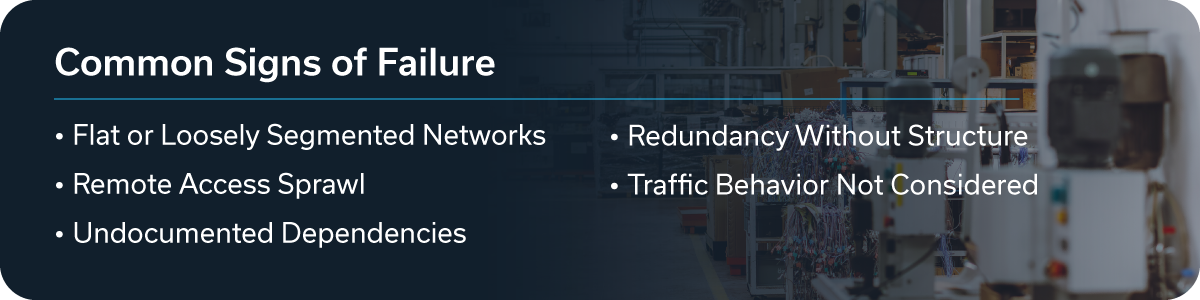
Redundancy Without Structure
Adding redundant links or devices can improve resilience, but only when implemented intentionally. In some environments, redundancy is layered onto existing infrastructure without redefining boundaries or understanding failover behavior. This can introduce complexity that makes troubleshooting more difficult and, in some cases, widens the scope of failure instead of containing it.
Traffic Behavior Not Considered
As systems grow, traffic patterns evolve. Broadcast amplification, unmanaged switching, or high-bandwidth “top talkers” can strain segments that were never designed for that scale. Without visibility and segmentation, performance issues appear unpredictable, even though they are often structural
These patterns are rarely resolved by replacing a single device. They require understanding the current architecture as a whole: how it was built, how it has evolved, and where its architectural weaknesses exist.
When an OT Network Assessment Makes Sense
Most industrial networks evolve over time. That evolution can make the architecture harder to clearly understand. An assessment becomes valuable when uncertainty starts to replace clarity.
That uncertainty often shows up in a few recognizable ways:
- Recurring issues that never seem fully resolved — troubleshooting addresses symptoms, but the root cause remains unclear or returns under load
- Modernization or expansion efforts — new systems, remote sites, or increased data demands are being introduced, and no one can confidently describe how those changes will affect the existing structure
- Limited or outdated documentation — device counts are estimates, segmentation boundaries are assumed, and remote access paths have accumulated over time
- Incidents spread further than expected — an outage, broadcast event, or unexpected access discovery reveals structural weaknesses that were not visible beforehand
In each case, the need is the same: a clear understanding of how the network is actually built and how it behaves. An assessment looks at the environment as a system, mapping devices, traffic flow, boundaries, and dependencies, so that future decisions are based on structure rather than assumption.
Request an OT network assessment from INS >>>
What INS Enables Through Structured OT Network Redesign
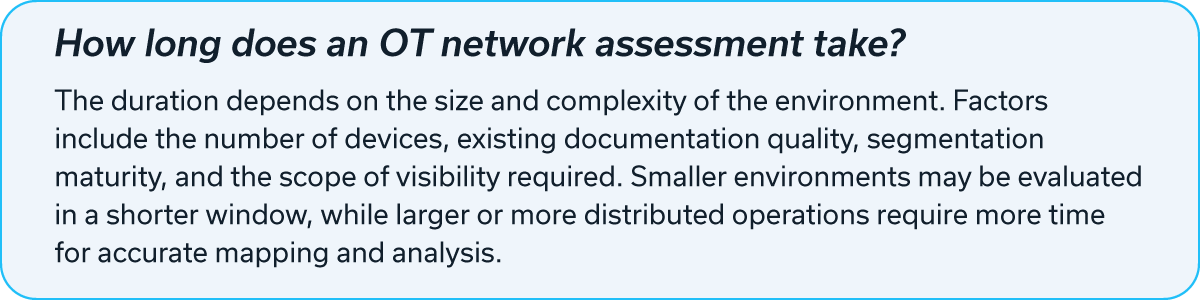
When INS evaluates and redesigns an OT network, the changes are structural. The goal isn’t to add complexity, it’s to create an environment that can be clearly understood, supported, and scaled over time
We define a well-designed OT network as scalable, manageable, reliable, and secure.
Scalable
INS restructures networks around defined zones and capacity planning rather than incremental expansion. By clarifying segmentation boundaries and validating bandwidth assumptions, new production systems, remote sites, or data initiatives can be integrated without destabilizing existing operations.
Manageable
Through validated device inventories, traffic analysis, and architectural documentation, hidden dependencies are surfaced. Remote access pathways are consolidated and normalized. The result is a network that teams can actually describe and troubleshoot.
Reliable
INS focuses on failure containment. Flat networks are reorganized into structured environments where problems are limited to their area of origin. Redundancy is evaluated in the context of segmentation and failover behavior so that resilience reduces impact rather than increasing complexity.
Secure
Security becomes part of the architecture itself. Defined zones, controlled communication paths, and structured integration to a plant DMZ reduce unnecessary exposure. Unknown or unmanaged entry points are identified and addressed as part of the redesign process.
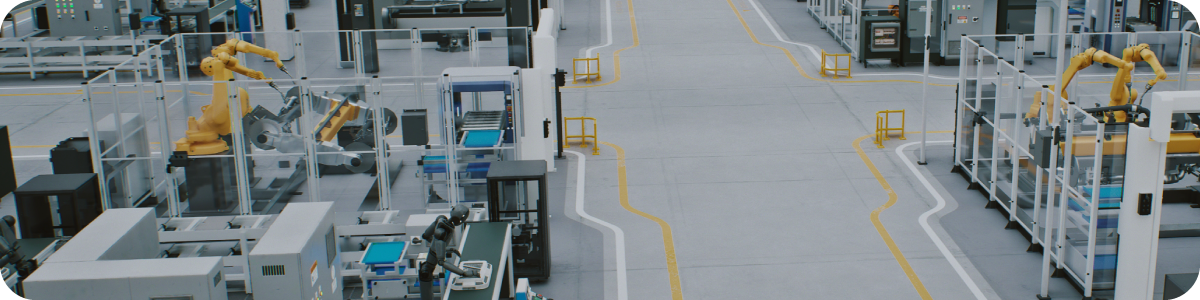
OT exists to support production. When the network’s architecture is unclear, production risk increases quietly over time
If the current architecture cannot be confidently described because device counts are uncertain, segmentation boundaries are assumed, or remote access has accumulated without structure, it may be time to step back and evaluate the system as a whole
INS conducts structured OT network assessments that identify architectural gaps, clarify dependencies, and define a path toward scalable, manageable, reliable, and secure operations