
Private 5G Networks for IoT: The Complete Enterprise Guide
November 19, 2025
Connectivity has become the backbone of modern industry. From smart factories and autonomous logistics to connected energy grids, enterprises are investing heavily in the Internet of Things (IoT) to improve efficiency, safety, and insight. Yet, the foundation that supports these connected systems, the network itself, often determines whether those digital ambitions succeed or stall.
For years, organizations have relied on Wi-Fi, Ethernet, or even public cellular networks to connect their operations. These technologies work well for basic connectivity, but they often struggle under the demands of mission-critical IoT: thousands of devices, ultra-low latency, guaranteed uptime, and airtight security.
That’s where private 5G networks come in.
Private 5G allows enterprises to build and manage their own dedicated wireless networks, offering carrier-grade performance with complete control over security, access, and traffic priorities. It’s the next evolution in industrial networking, purpose-built for organizations that need real-time visibility and reliability at scale.
In this guide, we explore what private 5G means for IoT-driven enterprises: how it works, how it differs from public 5G and Wi-Fi, what industries are leading adoption, and how your organization can begin its own journey.
What Are the Main Benefits of Private 5G Networks?
Private 5G isn’t just a faster connection. It’s a new way to think about connectivity itself. Enterprises gain the ability to own, customize, and secure their network infrastructure, creating the foundation for automation, analytics, and digital transformation.
Let’s explore the benefits driving enterprise adoption.
Network Control and Security
In a private 5G deployment, the organization, not a carrier, controls the network. That means data never leaves your environment unless you choose to share it. For industries like manufacturing, energy, and healthcare, where intellectual property and sensitive data are central, this control is transformative.
Private 5G networks use SIM-based authentication, end-to-end encryption, and localized data routing, giving enterprises the same level of security found in public carrier networks without exposure to external traffic. You determine who connects, what’s prioritized, and where data resides.
In short: you own your network, your policies, and your protection.
Ultra-Low Latency
Latency—how long it takes data to travel from one point to another—is the difference between seamless automation and system failure. With private 5G, ultra-low latency enables real-time communication for applications such as robotic control, augmented reality maintenance, and time-sensitive industrial automation.
That kind of responsiveness allows machines, sensors, and control systems to coordinate instantaneously, improving both efficiency and safety across the production floor.
Guaranteed Quality of Service (QoS)
Unlike Wi-Fi or public 5G, private networks can enforce deterministic Quality of Service (QoS). This means you can prioritize traffic for your most critical operations, such as PLCs, vision systems, or AGVs, while assigning lower priority to nonessential devices like employee tablets.
By using network slicing, you can carve out virtual lanes within the same infrastructure, each tuned for specific latency, throughput, or reliability requirements. The result: no dropped packets, no unpredictable congestion, and no interruptions to time-sensitive workloads.
Scalability and Future-Proofing
Private 5G is built to grow with your business. Whether you’re connecting dozens of sensors or hundreds of devices, the network’s design supports massive IoT scale without sacrificing performance.
Enterprises can start small, perhaps with a single facility or limited coverage zone, and expand over time. Because 5G standards evolve continuously, private 5G is future-ready, supporting potential use cases like AI-driven automation, digital twins, or high-bandwidth industrial video streaming.
Customization for Industry Needs
Every operation is different. A port’s needs look nothing like a hospital’s. Private 5G gives enterprises the flexibility to tune performance, coverage, and security to match their specific operational requirements.
Manufacturers can deploy low-latency, high-reliability cells across factory floors. Utilities can connect assets across remote regions. Warehouses can support fast-moving AGVs with uninterrupted handoffs. Whatever the environment, private 5G adapts to your use case, not the other way around.

How Do Private Networks Differ from Public 5G Networks?
Public 5G networks are designed for everyone. Millions of users share the same infrastructure. Private 5G, in contrast, is built for you. It’s your infrastructure.
Here’s how the two compare in practice.
Ownership and Control
|
Public Networks These belong to carriers. You buy access, not ownership. |
Private 5G You own and operate your own network, giving you authority over coverage zones, access, and management tools. |
Security and Data Privacy
|
Public Networks When your data travels across a public carrier, you rely on their encryption and routing. |
Private 5G In a private 5G setup, data stays behind your firewall, processed locally on your servers or at the network edge. |
Performance Characteristics
|
Public Networks Built for broad coverage and consumer convenience. |
Private 5G Engineered for consistency, with high throughput, low latency, and guaranteed reliability. No competing with surrounding traffic. |
Cost Structure
|
Public Networks Includes ongoing subscription costs and carrier dependencies. |
Private 5G Requires initial capital investment for infrastructure. Over time, enterprises often see lower total cost of ownership. |
How Are Private 5G Networks Different from Private Wi-Fi Networks?
Wi-Fi remains a cornerstone of enterprise networking, but it wasn’t built for industrial-grade performance. In environments where uptime equals profit, 5G provides a more resilient and scalable alternative.
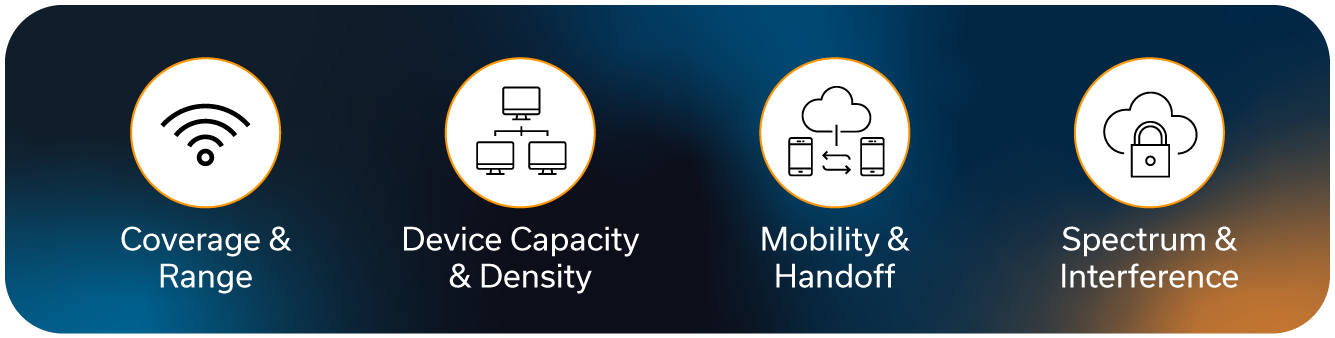
Coverage and Range
Wi-Fi coverage tends to degrade quickly over distance or through interference. Private 5G uses licensed or shared spectrum that penetrates walls and outdoor barriers more effectively. This allows fewer access points to cover larger areas, reducing infrastructure complexity.
Device Capacity and Density
A single 5G cell can handle hundreds of simultaneous device connections, whereas Wi-Fi performance drops as more endpoints compete for airtime. For IoT environments, this scalability is crucial.
Mobility and Handoff
Private 5G enables deterministic mobility between coverage zones, ideal for autonomous vehicles, mobile robots, or wearable tech. Wi-Fi often struggles to hand off connections smoothly, creating latency spikes or brief losses in connectivity.
Spectrum and Interference
Wi-Fi operates in unlicensed spectrum, where congestion and interference are common. Private 5G can use dedicated licensed or managed CBRS spectrum, ensuring predictable, interference-free performance for mission-critical tasks.
Can I Set Up a Private 5G Network for My Business?
Yes, but success depends on expert planning and integration. Private 5G combines radio infrastructure, core networking, edge computing, and security architecture.
Here’s what you need to know before getting started:
Eligibility and Prerequisites
Private 5G makes the most sense for organizations that:
- Operate large or multi-site facilities
- Use or plan to use industrial IoT or robotics
- Require ultra-reliable, low-latency connectivity
- Need strict control over data security or compliance
If your business involves real-time automation, mobile assets, or continuous uptime requirements, private 5G is a strong fit.
Deployment Models
Enterprises can approach deployment in three ways:
- On-Premises: The enterprise fully owns and manages infrastructure, including the radio network and core. This offers maximum control.
- Hybrid: The enterprise manages on-site elements while a partner or MSP manages the core.
- Managed Service: The entire system is operated by a managed service provider, giving enterprises access to private 5G capabilities without in-house expertise. Explore INS Managed Services here.
Timeline and Investment
Implementation can range from a few weeks to a few months, depending on facility size and integration complexity. 5G CBRS-based PCN networks feature minimal cost drivers, as GAA spectrum access requires no licensing fees, reducing expenses to hardware and optimized network design. Many enterprises begin with pilot projects in high-value areas, then expand based on results.
What Companies Are the Leading Providers of Private Networks?
Private 5G ecosystems bring together infrastructure vendors, system integrators, and managed service providers, each playing a critical role. Companies like INS design and deploy complete private 5G systems, integrating hardware, software, and edge computing into cohesive, secure networks tailored to your site and industry. We’ve spent decades connecting industrial environments—from control rooms to factory floors—with secure, high-performance networking solutions.
INS helps enterprises plan, design, and deploy private 5G networks that are purpose-built for industrial IoT. Whether it’s integrating with existing Ethernet or Wi-Fi infrastructure, configuring network slicing for critical workloads, managing devices through SIM-based access, or additional managed services and network support, INS delivers an end-to-end approach that’s practical, secure, and scalable.
Talk to an Expert: INS Private 5G Solutions →
Private 5G Network Use Cases Across Industries
Private 5G is not limited to one sector. It’s revolutionizing connectivity across industries.
Manufacturing and Industry 4.0
Factories use private 5G to enable real-time control, robotics coordination, predictive maintenance, and digital twins. With deterministic latency and seamless mobility, manufacturers can automate with confidence and agility.
Logistics and Warehousing
From automated guided vehicles to smart inventory tracking, private 5G ensures uninterrupted communication across large spaces. The result: fewer bottlenecks, higher throughput, and safer workflows.
Energy and Utilities
Private 5G strengthens field connectivity for critical assets—substations, pipelines, turbines—across remote or hazardous areas. Encrypted communication and real-time monitoring reduce risk and improve response times.
Healthcare and Life Sciences
Hospitals and labs use private 5G to support connected devices, telemedicine, and data-heavy imaging with minimal latency. Data remains on-premises, protecting patient privacy and ensuring compliance.
Transportation and Municipalities
Private 5G can enhance municipal operations, powering facilities, depots, and IoT systems with low-latency, secure connectivity. Note: CBRS networks excel for localized applications like AGVs and building automation, but aren’t practical for full citywide “Smart City” coverage or outdoor autonomous vehicle networks, which are better served by public cellular systems.

FAQ: Private 5G for Enterprise IoT
Q: Is private 5G only for large enterprises?
No. While it’s most common in large-scale operations, mid-sized businesses are adopting private 5G through shared spectrum and managed-service models.
Q: Can private 5G coexist with Wi-Fi and wired systems?
Absolutely. Many organizations run hybrid environments, using private 5G for mission-critical applications and Wi-Fi or Ethernet for general connectivity.
Q: Do I need a license to operate private 5G?
In the U.S., private 5G often uses CBRS spectrum (3.5 GHz), a shared-access band that allows enterprises to deploy without owning spectrum outright.
Q: How secure is private 5G?
Private 5G offers carrier-grade encryption, device authentication, and local data routing, making it one of the most secure wireless options available.
Q: What’s the ROI for private 5G?
Enterprises typically see value through reduced downtime, faster automation, and lower long-term operational costs. The payback period depends on scale and use case, but most organizations achieve measurable efficiency gains within the first year.
Closing Thoughts
Private 5G isn’t just another wireless technology; it’s the foundation for the next generation of industrial connectivity. It offers unprecedented control, reliability, and security, empowering enterprises to unlock the full potential of IoT and automation.
With the right partner, deploying private 5G doesn’t have to be complex.
Industrial Networking Solutions (INS) helps organizations plan, deploy, and manage private 5G networks tailored to their operations, bridging IT and OT with trusted expertise in secure industrial connectivity.
Ready to explore how private 5G can transform your business?