
Private 5G Network Security: Protecting Your Infrastructure and Data
December 18, 2025
Private 5G networks are transforming the way industrial and enterprise organizations operate. From autonomous manufacturing lines to connected vehicle fleets, private 5G delivers high-speed, low-latency connectivity where traditional networks can’t keep up. But as powerful as private 5G is, it also introduces new security responsibilities. Unlike public networks, you control every element—from the core network to edge devices—which means protecting your infrastructure, data, and devices is entirely in your hands.
Learn the basics of private 5G in our comprehensive guide.
Why Private 5G Security Matters
Private 5G networks differ from traditional Wi-Fi or public cellular deployments. They are often deployed in mission-critical environments such as manufacturing plants, energy facilities, logistics hubs, and healthcare campuses. In these contexts, network downtime or compromised data can have far-reaching consequences, from production delays to regulatory fines.
This type of technology operates under a shared responsibility model. While there are strong built-in protections, organizations must actively manage security policies, device provisioning, access controls, and integration with existing security infrastructure. Understanding these responsibilities is essential before deployment.
Threat Landscape for Industrial Networks
Industrial environments face a complex set of cyber threats. Malicious actors may attempt to gain access to sensitive systems through ransomware, phishing, or compromised IoT devices. Insider threats—whether malicious or accidental—can also create vulnerabilities. Private 5G networks, with thousands of connected endpoints including sensors, cameras, and autonomous machines, must be architected to defend against these sophisticated threats while maintaining performance.
Compliance & Regulatory Requirements
Industries such as manufacturing, transportation, energy, and healthcare are often subject to strict compliance requirements. Frameworks like NIST, ISO 27001, IEC 62443, and HIPAA dictate how data is handled, transmitted, and stored. Deploying a secure private 5G network ensures organizations meet these standards while providing documentation for audits and regulatory reporting.
Business Impact of Security Breaches
Even brief disruptions or data compromises can result in operational delays, financial losses, and reputational damage. In high-stakes industrial environments, network outages can halt production lines, prevent automated equipment from operating safely, or interrupt real-time telemetry used for predictive maintenance. Private 5G security mitigates these risks, ensuring continuity of operations and safeguarding sensitive data.
Built-In Security Features of Private 5G
Private 5G networks come with security mechanisms built into their architecture, providing a foundation for safe, reliable operations that meet 3GPP security standards. These security mechanisms are defined in 3GPP Technical Specifications (TS 33.501 for 5G security architecture) and represent significant improvements over previous cellular generations, including enhanced subscriber privacy, stronger authentication, and improved integrity protection.
SIM/eSIM Authentication
SIM and eSIM authentication ensure only approved devices can join the network. This hardware-level identity verification prevents unauthorized devices from connecting and reduces the risk of rogue access. For fleet or IoT deployments, SIM authentication also allows operators to control device access remotely, adding a layer of operational security.
Physical SIM cards offer simple deployment for fixed or semi-permanent devices, while eSIM (embedded SIM) enables remote provisioning and profile management, which is particularly valuable for large IoT fleets or devices in difficult-to-access locations. For high-security environments, physical SIMs may be preferred as they require physical access to compromise.
Encryption Standards
Private 5G provides encryption for both user plane data (application traffic) and control plane signaling. User plane encryption uses 128-bit or 256-bit encryption algorithms (NEA1/NEA2/NEA3), while integrity protection (NIA algorithms) ensures signaling cannot be tampered with. Additionally, IPsec tunnels may protect backhaul connections between RAN and core.
Network Slicing & Isolation
Network slicing allows operators to segment their private 5G infrastructure into multiple virtual networks, each with dedicated resources and security policies. This isolation protects critical applications, such as automated machinery or industrial control systems, from less-secure systems or guest networks. Network slices can be customized to enforce strict access control, QoS, and monitoring for each operational domain.
Private Spectrum Advantages
Using private spectrum offers inherent security benefits. Since only authorized devices and network components can access the spectrum, the risk of interference and eavesdropping is reduced. Private spectrum also allows organizations to control coverage areas and reduce signal exposure outside facility boundaries, further mitigating potential attack vectors.
Security Architecture Best Practices
Zero Trust Enforcement
Zero trust principles (“never trust, always verify”) are fundamental in private 5G deployments. Every device, application, and user must continuously authenticate, even inside the network perimeter. Implementing zero trust minimizes the risk of lateral movement by attackers if a device is compromised.
Micro-segmentation extends zero trust principles by creating granular security zones around individual workloads or device groups. In industrial environments, this might mean isolating safety-critical control systems from general monitoring traffic, even within the same network slice.

Network Segmentation
Segmenting the network into logical or physical zones also helps ensure that only authorized users and devices can access critical systems. Access control policies should define which endpoints can communicate, under what conditions, and with what privileges. Segmentation also helps contain potential breaches, preventing a single compromised device from affecting the entire network.
Edge Security
Private 5G often integrates edge computing to process data closer to devices, reducing latency and improving performance. Edge nodes must be secured with endpoint protection, encrypted communication to the core, and continuous monitoring to detect abnormal behavior. For industrial IoT, securing edge nodes ensures that operational data remains reliable and tamper-proof.
Core Network Hardening
Lastly: the core network is the backbone of private 5G operations and must be hardened against attacks. Firewalls, intrusion detection systems, secure configuration management, and strict administrative controls help maintain a resilient core. Regular vulnerability assessments and stress testing ensure the network withstands potential cyberattacks.
Device and IoT Security
Connected devices are the lifeblood of private 5G networks, but they are also the first line of defense.
Device Authentication and Provisioning
Every device must prove it belongs on the network. SIM- or certificate-based authentication verifies legitimacy before transmission, preventing unauthorized access. Centralized provisioning enables fleet managers, manufacturing operators, and IT teams to quickly onboard new devices while maintaining strict security controls.
5G introduces Subscription Concealed Identifier (SUCI), which encrypts the device's permanent identifier (SUPI) during authentication, preventing the IMSI-catching attacks that could track devices on earlier cellular generations. This is a significant security improvement for industrial IoT deployments.
Firmware and Software Management
Outdated software is a common vulnerability. Coordinated firmware updates, signed software, and rollback capabilities ensure devices remain secure without interrupting operations. This approach protects fleets, industrial sensors, and IoT endpoints from known exploits and operational disruptions.
Certificate Management
Certificates ensure trusted communication between devices and network services. Managing their full lifecycle, including issuance, renewal, and revocation, is essential in networks with thousands of endpoints. Well-managed certificates prevent unauthorized connections and maintain trust across the entire system.
Ongoing Security Operations
Security isn’t a one-time task—it’s continuous. Here are a few key considerations:
Monitoring & Threat Detection
Active monitoring identifies anomalies in real-time. AI-driven analysis and alerting systems help teams respond to potential threats before they escalate, ensuring consistent network reliability.
Incident Response Planning
Even with preventative measures, incidents can occur. A defined response plan ensures swift containment, remediation, and recovery, minimizing operational downtime.
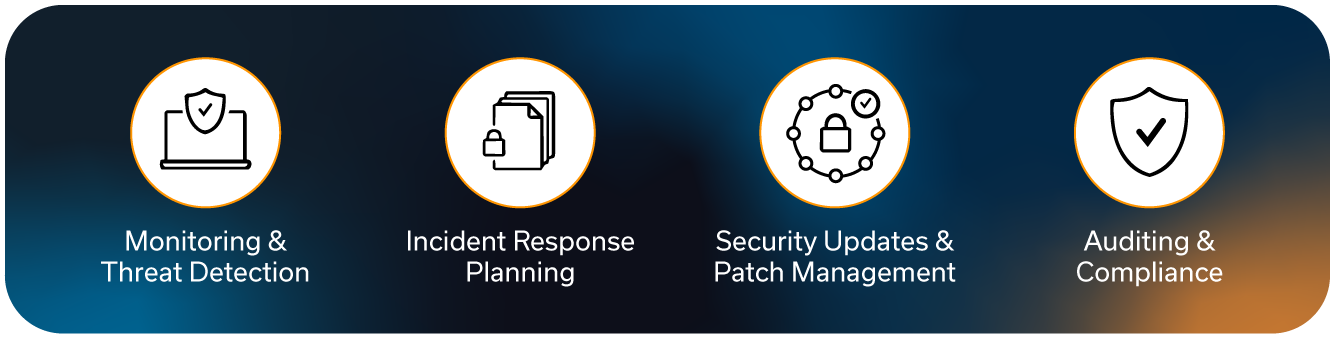
Security Updates & Patch Management
Regular updates to network software, device firmware, and edge applications are essential to defend against evolving threats. Patch management schedules should be automated and validated to maintain operational continuity.
Auditing & Compliance
Continuous auditing verifies adherence to security policies and regulatory requirements. Logs, reports, and periodic reviews demonstrate compliance and provide insights for ongoing improvements.
Common Security Vulnerabilities
Organizations should proactively assess risk and implement mitigation strategies for:
- Unauthorized device access (unregistered sensors or personal devices attempting to attach)
- Weak or default credentials (common in PLCs, sensors, and cameras)
- Inadequate segmentation (flat networks where OT and corporate traffic overlap)
- Outdated firmware, typical in ruggedized devices with long lifecycles
- Misconfigured edge nodes, often caused by limited IT/OT visibility
- SIM cloning or credential theft
- Unmanaged network elements (switches, routers without security monitoring)
- Insufficient backhaul security (unencrypted connections between UI and OT networked endpoints)
- Physical security gaps (unsecured radio equipment accessible to unauthorized personnel)
- API vulnerabilities in network management interfaces
INS recommends a structured risk assessment framework to identify vulnerabilities, prioritize threats, and implement layered mitigation strategies before deployment.
Security Considerations When Choosing Providers
Selecting the right private 5G provider is critical not only for network performance but also for the security of your infrastructure, data, and connected devices. Organizations often underestimate how much the provider’s security posture impacts overall risk. Consider the following factors when evaluating potential partners:
Vendor Security Certifications
Certifications demonstrate that a provider follows rigorous security standards. Look for ISO 27001, SOC 2, or IEC 62443 compliance, which indicate adherence to best practices for data protection, network security, and operational controls. Certified providers are more likely to maintain consistent policies for patch management, encryption, access controls, and incident response, giving you confidence that your private 5G deployment meets enterprise-grade standards.
Operational Transparency
Your private 5G provider should offer full visibility into network security operations. This includes real-time monitoring dashboards, incident reporting, and access to audit logs. Transparency allows your IT and security teams to verify compliance, track anomalies, and respond proactively to potential threats. Avoid providers who treat security as a “black box.” You need insight into how your data is protected and how devices are authenticated and managed.
Patch Management and Update Protocols
Ask potential providers how they manage software and firmware updates. Regular, tested, and signed updates are crucial for preventing exploitation of known vulnerabilities. Providers should offer automated patch deployment, rollback capabilities in case of issues, and clear notifications when updates are applied. This ensures your fleet, IoT devices, and industrial endpoints remain secure without interrupting operations.
Network Segmentation and Isolation
Evaluate whether the provider can implement network slicing or segmentation for your deployment. Proper isolation separates sensitive traffic from less-critical data streams, limiting lateral movement of threats in the unlikely event of a breach. Providers that offer customizable segmentation can tailor security policies to different teams, applications, or device classes, providing additional operational resilience.
Incident Response Support
Even with preventative measures, security incidents can occur. A strong provider will have a documented incident response plan and offer active support in containment, remediation, and post-incident analysis. Confirm that your provider’s team can coordinate with your internal IT and security teams and provide clear communication during security events.
Security Integration with Existing IT Systems
Finally, consider how the provider integrates with your existing IT and security systems, such as SIEMs, endpoint protection platforms, and identity management solutions. Seamless integration enables centralized monitoring and reduces complexity, making it easier to enforce consistent security policies across both private 5G and enterprise IT infrastructure.
Protecting your private 5G network starts with a proactive, layered approach, combining encryption, device authentication, network isolation, and ongoing monitoring. At INS, we help organizations design and deploy private 5G networks that are secure by design, giving teams confidence that their infrastructure and data remain protected while operations scale.