Your Industrial AI Has a Hardware Problem
Walter Brumbalow, Wireless Network Manager | July 14, 2026
Many industrial AI projects are evaluated with too little attention paid to the network. Teams scrutinize the model, the vendor, the integration — and treat the network as a given. It isn't.
The gap between what an industrial AI deployment promises and what it delivers in production is often tied to infrastructure limitations, many of which can be identified before go-live.
What Industrial AI Actually Demands From Your Network
Most industrial AI applications (predictive maintenance, edge inference, automated monitoring) aren't particularly bandwidth-hungry. What they require is a network that delivers data reliably, repeatedly, and without gaps.
Three network-level issues commonly undermine industrial AI deployments:
Dropout events that corrupt training data. A predictive maintenance model trained on sensor data interrupted by network outages may not accurately reflect your equipment's actual behavior. It may learn from incomplete or distorted data, increasing the likelihood of inaccurate outputs.
Latency spikes that delay alerts. An alert system that depends on a sluggish or intermittent connection may not surface issues while there is still time to act. By the time connectivity is restored, the opportunity to intervene may have narrowed or passed.
Architecture that wasn't designed for edge deployment. Edge AI is increasingly common in remote and industrial environments, and it depends on consistent upstream communication. A network that performs adequately for traditional SCADA traffic may not support the sustained data flow that edge inference requires.
The Network Gaps That Undermine Industrial AI
Every industrial network has vulnerabilities. Most teams don't discover them until something downstream breaks. It's worth knowing which apply to yours before you add AI to the stack.
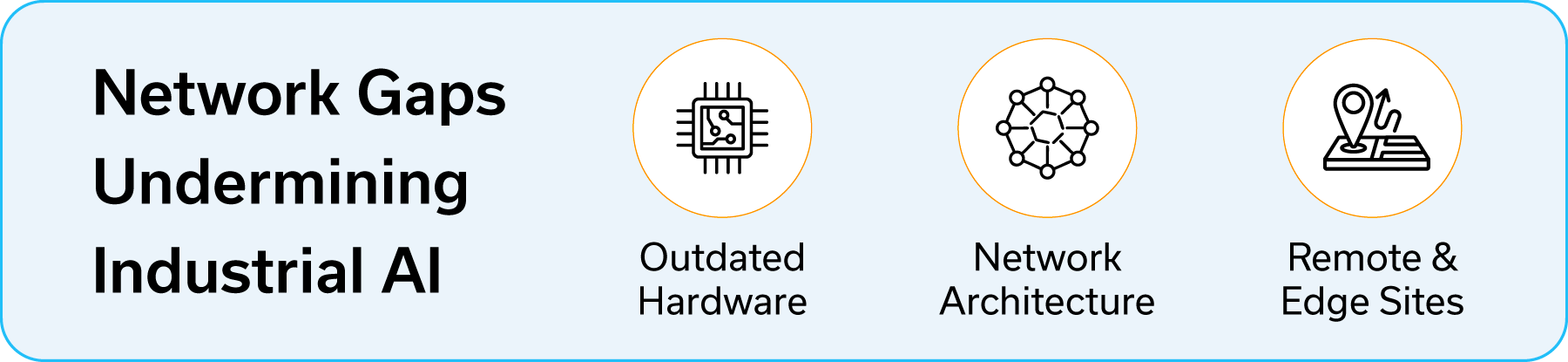
Hardware that was never intended to carry AI workloads.
A lot of industrial networking hardware was deployed years ago for a narrower purpose: connecting PLCs, enabling remote access, routing standard SCADA traffic. AI deployments ask something different of it: sustained, high-integrity data transmission, often at more endpoints, with stricter uptime requirements.
Flat or poorly segmented network architecture.
Industrial environments that weren't built with segmentation in mind create problems for AI deployments beyond performance. A flat OT network means a single event — a device failure, a security incident, unexpected traffic from a new application — can degrade the entire environment. Segmentation isn't just a security practice; it can also help improve the predictability of AI workloads.
Remote and edge sites where coverage assumptions don't hold.
Network performance at your main facility often isn't representative of what's happening at remote sites. If your AI tools are deployed at the edge, they're running on whatever infrastructure exists there — whether or not it was designed to support them.
The Infrastructure Conversation That Happens Too Late
By the time most teams think about the network, the deployment is already underway. That's where projects run into trouble. A few questions worth getting answers to before your next AI or automation deployment kicks off:
- Is your current hardware capable of handling the sustained data load this application requires?
- Is your network segmented in a way that isolates AI traffic from other OT workloads?
- Do your remote and edge sites have the infrastructure to support what you're deploying there?
- What's your plan if a critical network segment goes down after go-live?
These are infrastructure decisions. Like most infrastructure decisions, the ones made early are significantly easier (not to mention cheaper) to get right than the ones you're forced to revisit under pressure.
The Two Layers to Get Right
Industrial AI infrastructure has two layers.
The first is the physical and logical network layer: the hardware, the architecture, the design decisions that determine how data moves through your operation. Managed switches, industrial routers, network segmentation, redundancy paths, and the configuration that ties it together. INS has been designing and troubleshooting this layer for over 25 years. Here’s how we do it ↗
The second layer is the connectivity management layer — how your data actually gets where it needs to go once it leaves the local network environment. Companies that rely on a single layer of connectivity (ex. your ISP) have huge failure risks without redundancy and resiliency, and that's where Solve Networks specializes. Their focus on building situationally-aware connectivity resiliency for industrial and IoT environments can help reduce single-point failure risk by providing multi-network failover solutions with dynamic SIM provisioning and (most importantly), visibility into your connectivity in one pane of glass, helping authorized users identify potential connectivity gaps.
The Bottom Line: Start With the Infrastructure
Before your next AI or automation project, it's worth taking an honest assessment of the network it's going to depend on. The questions in this blog are a starting point. The answers will require a real look at your hardware, your architecture, and whether your network was actually built to carry what you're about to put on it.
INS has been designing and deploying industrial networks for over 25 years. If you're planning an AI or automation project and want to make sure the infrastructure is ready for it, let’s take a look.
Start the Conversation with INS Today
 |
Walter Brumbalow is INS's Wireless Network Manager, leading teams that design, deploy, and optimize wireless networks for industrial environments — with deep expertise in CBRS, Wi-Fi, and backhaul solutions. With more than two decades in network engineering and industrial systems integration, including over 14 years at INS, Walter brings hands-on, field-tested knowledge to every network he touches.
|