Private 5G vs. Wi-Fi: Which Technology Is Right for Your Business?
December 18, 2025
In today’s enterprise environment, connectivity isn’t just a convenience. It is the backbone of productivity, safety, and digital transformation. From smart factories to logistics hubs and connected healthcare environments, organizations increasingly rely on high-performance networks to power their IoT devices, automation systems, and mission-critical applications.
When it comes to enterprise-grade wireless, two technologies dominate discussions: private 5G networks and Wi-Fi. Both technologies provide wireless connectivity, but their design, performance characteristics, and deployment models differ significantly. Selecting the right solution (or combination of solutions) can impact operational efficiency, security, and long-term ROI.
If you’re new to private 5G, we recommend starting with our Private 5G Networks Complete Guide for foundational insights before diving into this comparison.
Understanding the Core Differences
At a high level, both private 5G and Wi-Fi deliver wireless connectivity, but they differ fundamentally in architecture, spectrum use, and how they handle data traffic. The primary distinction lies in how they manage access: Wi-Fi is contention-based, while 5G is deterministic.
Technology Standards and Architecture
Private 5G (Scheduled Access): Leveraging 3GPP standards (LTE and 5G NR), Private 5G uses a centralized scheduler. The network dictates exactly when each device can transmit and receive data. This eliminates data collisions and guarantees performance even under heavy load. Enterprises control their own radio access networks (RAN) and core infrastructure, resulting in ultra-reliable, low-latency connections.
Wi-Fi (Contention-Based): Built on IEEE 802.11 standards, Wi-Fi operates on a "Listen-Before-Talk" principle. Devices must compete for airtime; if the channel is busy, they wait. While Wi-Fi 6 and 7 introduce efficiency improvements like OFDMA, the protocol remains susceptible to variable latency (jitter) when device density peaks or physical interference occurs.
Spectrum and Frequency Bands
Private 5G: In the United States, the majority of private 5G networks operate in the 3.5 GHz CBRS band (3550–3700 MHz). This shared spectrum is dynamically managed by FCC-certified Spectrum Access Systems (SAS) to prevent interference. It offers two tiers:
- Priority Access Licenses (PALs): Previously auctioned, county-based protected channels are now available largely through secondary market leasing.
- General Authorized Access (GAA): License-by-rule access, available to any enterprise, offering performance comparable to licensed spectrum at a fraction of the cost.
Wi-Fi: Continues to operate in unlicensed 2.4 GHz, 5 GHz, and 6 GHz (Wi-Fi 6E/7) bands. While accessible, these bands are prone to congestion from neighboring networks and non-Wi-Fi interference.
Coverage and Mobility
Private 5G: Provides wide-area coverage with significantly fewer access points (radios) due to higher transmit power and better signal propagation. Crucially, 5G supports seamless mobility. The network controls the handover as a device (like a forklift or robot) moves between radios, ensuring zero packet loss.
Wi-Fi: Coverage is more localized, often requiring dense deployments of access points. In Wi-Fi, roaming is device-controlled. The client device decides when to switch access points, which often leads to "sticky client" issues where a device clings to a weak signal. This causes latency spikes or disconnections in moving vehicles.
Latency and Speed
Private 5G: Delivers consistently low and, more importantly, deterministic latency. This predictability is essential for precise robotics and safety systems.
Wi-Fi: Offers competitive, often superior peak speeds for file transfers in office environments. However, latency varies significantly ("jitter") based on network load, making it less suitable for real-time industrial control.
Device Capacity and Density
Private 5G: A single 5G cell can support thousands of connected devices simultaneously using small "resource blocks" to keep devices connected without clogging the network. This is ideal for high-density sensor environments.
Wi-Fi: Typical access points support 50–200 devices effectively. High-density Wi-Fi requires complex channel planning and more hardware infrastructure to match the capacity of a single 5G radio.
Reliability and Uptime
Private 5G: Provides deterministic performance, redundancy capability, and carrier-grade reliability, which is essential for critical enterprise operations. Operators can design private 5G networks with failover and network slicing to ensure uninterrupted service.
Wi-Fi: reliability can be affected by interference, channel saturation, and physical obstructions, requiring proactive monitoring and management to maintain enterprise-level uptime.
Reliability, Security, and Compliance
Reliability and Uptime
Private 5G provides carrier-grade reliability. Operators can design networks with built-in redundancy capabilities and network slicing. This virtually segments the network to guarantee resources for critical applications (e.g., separating security camera traffic from autonomous vehicle control). Wi-Fi reliability is heavily dependent on the immediate RF environment and is more susceptible to interference and channel saturation.
Security and Compliance
Security is a major differentiator.
Private 5G: Utilizes SIM-based authentication (physical or eSIM). This eliminates password management and prevents unauthorized devices from accessing the network. It offers end-to-end encryption and keeps data routing entirely local (on-premise), which is vital for data sovereignty.
Wi-Fi: Relies on WPA2/WPA3 encryption. While secure for general use, credentials can be shared or compromised more easily than physical SIM cards. Wi-Fi signals are also easier for bad actors to jam or intercept using commodity hardware.
For industries like healthcare and energy, the granular traffic control of Private 5G simplifies compliance with HIPAA, NERC CIP, and ISO 27001.
Use Case Analysis: Making the Decision
When Private 5G Is the Better Choice
- Mobility is critical: Autonomous Mobile Robots (AMRs), forklifts, and fleet vehicles.
- High Density: Connecting hundreds of IoT sensors in a single facility.
- Determinism: Automation requiring deterministic latency.
- Wide Coverage: Large indoor/outdoor areas, ports, mines, or sprawling campuses.
When Wi-Fi Is the Better Choice
- General IT: Legacy devices, laptops, and printers in office/carpeted spaces.
- High Bandwidth: Non-critical bulk file transfers or static video streaming.
- Cost/Simplicity: Small static environments where cabling is easy and interference is low.
- Guest Access: BYOD scenarios where SIM provisioning is impractical.

Hybrid Approaches and Cost Considerations
The Hybrid Model
Most enterprises will not choose one over the other; they will use both. A hybrid model uses Private 5G for OT (Operational Technology) and mission-critical assets, while Wi-Fi handles IT, legacy devices, and guest traffic. This ensures that a heavy file download on the Wi-Fi network never impacts the safety signals of a robotic arm on the 5G network.
Cost Analysis (TCO)
Private 5G: Higher initial complexity, but infrastructure costs are dropping. The Total Cost of Ownership (TCO) over 3–5 years is often lower for large areas because 5G requires far fewer radios (1 radio vs. 10-20 Wi-Fi APs) and significantly less cabling/switching infrastructure.
Wi-Fi: Lower upfront hardware cost per unit. However, in industrial settings, the cost of running cables to dozens of APs, coupled with the operational cost of troubleshooting downtime, can exceed the cost of cellular deployment over time.
Implementation: Getting Started
Deploying Private 5G has evolved. While complex integrations still exist, modern "Network-in-a-Box" and cloud-managed solutions have reduced deployment timelines from months to weeks.
Partnering with experienced providers like Industrial Networking Solutions (INS) ensures smooth deployment. INS specializes in integrating Private 5G and Wi-Fi, helping enterprises perform the necessary site surveys, spectrum analysis, and network design to optimize both technologies.
Decision Matrix:
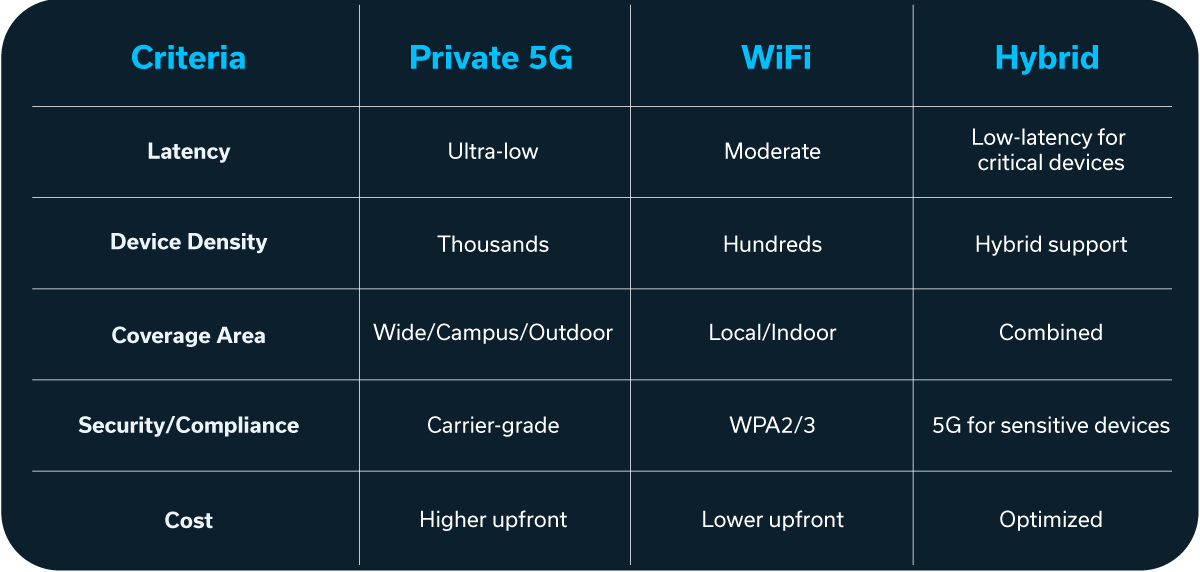
Alt Text: Chart comparing the criteria for Private 5G vs. Wi-Fi vs. Hybrid options for enterprises, including access method, mobility, coverage radius, security/compliance, and primary use.
The decision between private 5G and enterprise Wi-Fi is not binary. It depends on operational requirements, risk tolerance, and long-term strategy. Private 5G offers predictable performance, carrier-grade security, and dense device connectivity, while Wi-Fi provides flexible, cost-efficient connectivity for general-use environments with legacy devices.
Ready to optimize your network strategy? Contact INS today for professional guidance of a tailored mix of Private 5G and Wi-Fi to transform your enterprise network.