How Manufacturing Systems Work
Joel Albert, Vice President of Sales - Industrial Technologies | March 16, 2026
Understanding ERP, MES, SCADA, PLCs, and the network that connects them.
Walk into any manufacturing facility and you’ll hear people talk about machines, uptime, and throughput. But what actually keeps production moving goes far beyond machines and materials.
Modern manufacturing environments rely on a tightly integrated stack of systems, each responsible for a different layer of decision-making.
- Some decide what should be built.
- Some decide how it should be built.
- Some decide what’s happening right now.
- And some simply make the machines move.
At a high level, this stack is typically made up of four core systems: ERP, MES, SCADA, and PLCs. If those acronyms don’t mean anything to you right now, keep reading.
These layers form the backbone of modern manufacturing, and none of them operate in isolation. When they work together, operations feel smooth and predictable. When they don’t, small issues can surface quickly and may spread.
ERP: Enterprise Resource Planning
Where manufacturing strategy starts.
ERP lives at the business level. It’s the system that turns demand, forecasts, and budgets into production plans by managing:
- Production planning and demand forecasting
- Inventory and materials
- Purchasing and supplier coordination
- Costs, financials, and reporting
ERP answers big-picture questions:
- What should we make?
- When should we make it?
- What will it cost?
It doesn’t run machines, but it sets expectations for every system below it. When ERP data is late or disconnected from execution, the plant floor feels it immediately in the form of missed schedules, excess inventory, or rushed changeovers.
MES: Manufacturing Execution System
Where manufacturing plans meet reality.
MES is where strategy hits the shop floor. It takes ERP plans and manages how they actually play out by controlling:
- Work orders and routing
- Scheduling adjustments in real time
- Quality checks and traceability
- Operator instructions and production feedback
MES answers the questions that matter during a shift:
- What should be running right now?
- Are we ahead or behind?
- Where are problems forming?
Because MES sits in the middle of everything, it depends heavily on clean, consistent data flow. If communication breaks down here, teams compensate with spreadsheets, radio calls, and manual workarounds, none of which are scalable solutions.
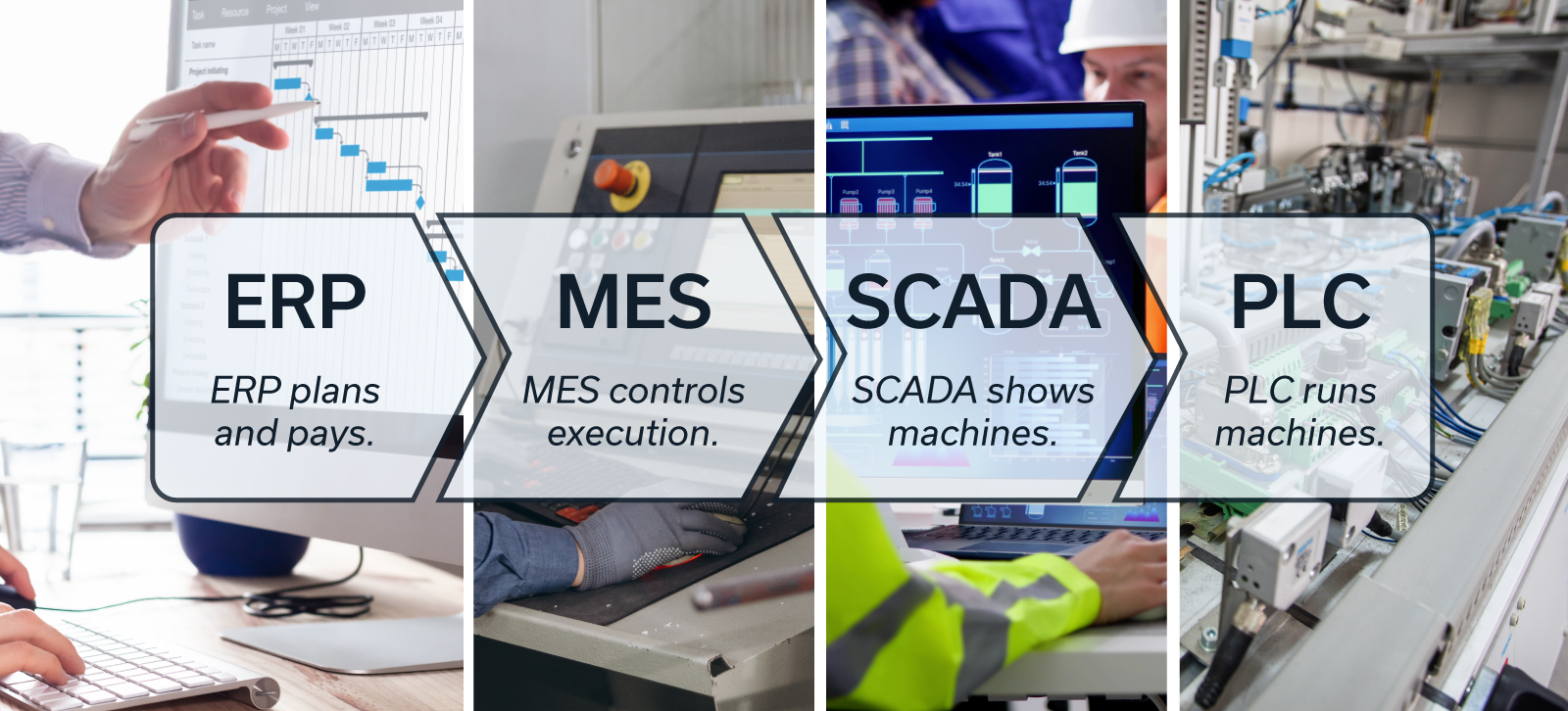
SCADA: Supervisory Control and Data Acquisition
The window to manufacturing operations.
SCADA gives operations teams eyes on the process. It pulls in data from control systems and presents:
- Machine status and alarms
- Process variables like temperature and pressure
- Trends that show what’s drifting vs. what’s stable
SCADA answers:
- What’s happening right now?
- Is something about to go wrong?
When SCADA is reliable, operators act quickly and confidently. When it isn’t, they’re left reacting instead of anticipating, and that downtime gets more expensive by the minute.
PLCs: Programmable Logic Controllers
Where machines are set in motion.
At the foundation of the manufacturing stack are purpose-built industrial computers responsible for executing control logic in real time. PLCs manage:
- Motors and drives
- Valves and actuators
- Speed, torque, sequencing, and safety interlocks
PLCs require deterministic communication and consistent network performance. They are designed for precision, not uncertainty. Network instability at this level can result in production stoppages or equipment faults and may contribute to safety concerns.
The Common Thread: Industrial Networks
Each layer in the manufacturing stack has different performance, security, and availability requirements, but they all rely on the same underlying network.
A well-designed industrial network can help provide:
- Reliable data flow between systems
- Proper segmentation between IT and OT environments
- Low-latency communication where timing matters
- Secure access designed to minimize disruption to operations
When networks are treated as an afterthought, manufacturers often experience issues that appear to be system issues, but are actually connectivity problems in disguise.
Building Manufacturing Systems That Work Together
Reliable manufacturing operations aren’t achieved by optimizing individual systems in isolation. They are achieved by designing the entire stack: systems and network together.
When ERP, MES, SCADA, and PLC environments are aligned and supported by the right connectivity strategy, manufacturers can make better decisions, respond quickly to issues, improve uptime and throughput, and build a stronger foundation for future automation and growth.
Thoughtful network design, industrial expertise, and end-to-end execution make the difference. Get all three with INS as your partner.