
Best POTS Replacement Solutions for Businesses
January 28, 2026
As businesses confront the ongoing phase-out of traditional POTS lines, finding a reliable POTS replacement solution has never been more critical. Facility managers, IT directors, and decision-makers must help ensure that life-safety systems such as fire alarms, elevator emergency phones, and security systems remain fully operational even as telecom carriers retire legacy copper networks. The stakes are high: any disruption in these critical systems can create compliance risks, operational interruptions, and safety hazards.
This guide walks through the leading POTS replacement solutions available today, evaluating each based on reliability, scalability, and regulatory compliance. You’ll gain insight into cellular-based, VoIP-enabled, and fiber-to-the-premises options, with detailed comparisons of key features, advantages and limitations, and ideal use cases. By understanding the technical differences and deployment requirements of each approach, businesses can make informed decisions that minimize risk and ensure service continuity as legacy copper lines are retired.
While this guide highlights solution types, INS serves as an example of a provider capable of delivering certified, compliant, and monitored POTS replacement services. For organizations looking to proactively safeguard critical systems, exploring these solutions now (not after service disruptions occur) is essential.
If you’re ready to evaluate your options and help ensure uninterrupted service, learn more about professional POTS replacement services today.
Why You Need a Reliable POTS Replacement Solution
Even as traditional POTS lines have been the backbone of business communications for decades, their retirement creates an urgent need for reliable replacement solutions. Businesses cannot afford downtime or failure in critical systems. Fire alarms, elevator emergency phones, security systems, and even point-of-sale terminals rely on dependable phone connectivity. A robust POTS replacement solution helps ensure these systems continue to operate reliably, protecting both employees and customers while maintaining regulatory compliance.
Critical System Requirements
Reliable POTS replacement solutions must meet the same operational standards that legacy copper lines provided. Fire alarm panels, for example, require uninterrupted connectivity to monitoring centers, while elevator emergency phones must comply with ASME A17.1 safety standards. Businesses need a solution that supports high availability and signal reliability under all circumstances, including power outages or network congestion.
Compliance and Safety Needs
Local jurisdictions and industry standards dictate that life-safety systems maintain continuous communication. A failure in these systems due to discontinued POTS lines can result in code violations, fines, and liability issues. Choosing a compliant solution allows you to remain operational in accordance with applicable code requirements. These are life emergency systems and are enforceable.
Reliability Expectations
A high-quality POTS replacement must offer redundancy, monitoring, and failover capabilities to support uninterrupted service. Providers that demonstrate consistent performance history, technical expertise, and proactive support distinguish themselves as reliable options.
The “best” solution depends on the specific requirements of your business. Factors include single vs. multi-line needs, geographic coverage, integration with existing infrastructure, and long-term scalability. Decision-makers should evaluate options against both immediate operational requirements and future growth.
Types of POTS Replacement Solutions Available
As reliable POTS line services disappear, businesses must understand the replacement technologies available today. Each alternative comes with its own strengths, capabilities, and ideal use cases, and the right fit depends on the systems you’re supporting, the level of reliability required, and the environment in which they operate. Below is a clear breakdown of the most common POTS replacement options businesses rely on as copper infrastructure sunsets.
Cellular POTS Replacement Solutions
Cellular-based POTS alternatives use LTE or 5G wireless networks to deliver dial-tone connectivity without relying on legacy copper. These solutions are popular because they offer fast deployment, nationwide coverage, and strong reliability with built-in redundancy. Most units include battery backup options, making them well-suited for life-safety systems such as fire panels and elevator emergency phones.
Best for:
- Fire alarm control panels
- Elevators and call boxes
- Security systems
- Remote or distributed facilities
Cellular networks are modern, actively maintained, and do not depend on aging copper, making them one of the most dependable replacements on the market.
VoIP (Voice over IP) Solutions
VoIP delivers phone service over the internet, making it a natural choice for organizations that already rely on broadband connectivity. VoIP is flexible, scalable, and cost-effective, offering advanced call features for administrative or office-based systems.
Best for:
- Office phones
- Call centers
- Administrative lines
- Multi-site businesses with strong network infrastructure
VoIP often requires additional hardware or adapters to support analog equipment, and life-safety applications may require enhanced failover to remain compliant.
Fiber-Based Voice Services
Some carriers offer digital voice services delivered via fiber networks. These services can provide strong reliability, excellent audio quality, and high bandwidth, but availability varies greatly by region.
Best for:
- Facilities with existing fiber service
- High-traffic call environments
- Businesses in metro areas with strong carrier infrastructure
Fiber solutions may still lack built-in support for legacy analog equipment, requiring specialized gateways. Additionally, power outages can interrupt service unless backup systems are deployed.
Hybrid Solutions (Analog + Cellular + VoIP)
Hybrid approaches blend multiple technologies to offer maximum reliability and compatibility. For example, a facility may implement cellular POTS replacement for fire alarms while using VoIP for administrative lines.
Best for:
- Complex facilities with diverse POTS-dependent systems
- Organizations requiring both redundancy and compatibility across multiple platforms
Hybrid approaches allow businesses to phase out copper strategically, system by system, without disruption.
| POTS Replacement Option | Best for: |
| Cellular Solutions |
|
| VoIP Solutions |
|
| Fiber-Based Voice Services |
|
| Hybrid Solutions |
|
How to Choose the Right Approach
Selecting the right mix of POTS replacement technologies depends on:
- Compliance requirements
- System type (elevators vs. POS vs. alarms)
- Environmental constraints
- Building layout and connectivity
- Budget and long-term operational needs
Your best path may include more than one solution, and partnering with expert POTS service providers can help ensure a seamless, compliant migration.
Cellular POTS Replacement Solutions
Cellular POTS replacement, often referred to as “wireless POTS,” has quickly become one of the most widely adopted alternatives to copper lines. As traditional carriers retire their analog infrastructure, cellular-based solutions offer reliability, flexibility, and nationwide coverage that legacy POTS lines can no longer match. For many organizations, this technology represents the most practical and cost-effective way to keep fire alarms, elevators, security systems, and life-safety devices fully operational and compliant.
Below is an in-depth look at how cellular POTS replacement works, where it performs best, and what to evaluate when comparing systems.
How Cellular POTS Replacement Works
Cellular-based POTS alternatives use LTE or 5G wireless networks to deliver dial-tone connectivity without relying on legacy copper. These solutions are popular because they offer fast deployment, nationwide coverage, and strong reliability with built-in redundancy. INS implements three leading cellular platforms: INS implements purpose-built cellular platforms designed to emulate traditional POTS functionality for life-safety systems.
Key components typically include:
- Multi-carrier LTE/5G modem
- Analog FXS ports for fire panels, phones, and alarms
- Battery backup capable of hours of operation
- Built-in failover to maintain connectivity during outages
- Remote monitoring dashboards for health and alerts
Because these devices mimic traditional POTS lines, they work with nearly all existing analog systems without major rewiring. Installation can often be completed in under an hour per line.
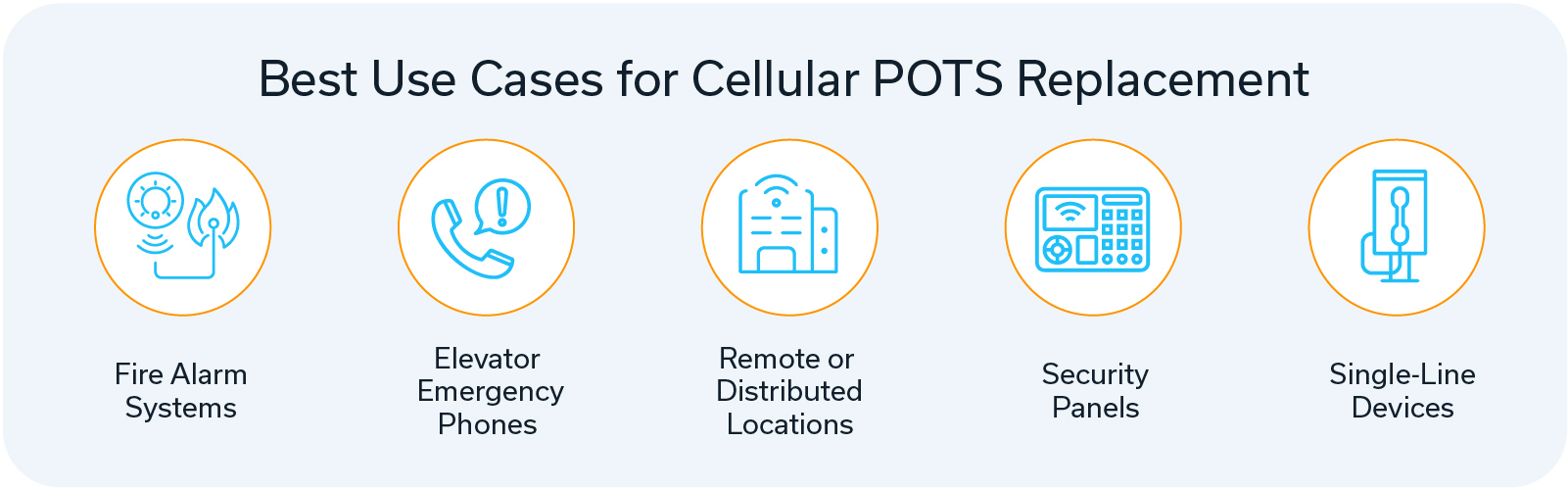
Best Use Cases for Cellular POTS Replacement
Cellular POTS solutions are best suited for critical, single-line, or remote applications where uptime, compliance, and simplicity are paramount. The most common use cases include:
- Fire Alarm Systems: Cellular endpoints can meet UL-864, NFPA 72, and local AHJ requirements when properly configured with battery backup.
- Elevator Emergency Phones: These systems require reliable connectivity during power outages, making battery-backed cellular a strong fit.
- Remote or Distributed Locations: Warehouses, outbuildings, parking garages, and rural sites often lack broadband but have strong cellular coverage.
- Security Panels: Safety alarms, access control, and monitoring systems depend on dependable analog signaling that cellular POTS can deliver.
- Single-Line Devices: Door phones, call boxes, gate controls, and point-of-sale terminals that don’t require multi-line scalability perform well on wireless POTS.
When the copper line disappears, cellular is often the fastest and most reliable stop-gap or long-term replacement.
Key Features to Look For
Not all cellular POTS solutions are equal. When evaluating options from POTS landline providers, focus on features that support safety, reliability, and compliance:
- Battery Backup Duration: Look for systems offering at least 8 to 24 hours of standby power.
- Network Redundancy: Multi-carrier SIMs or carrier failover significantly reduce the risk of downtime.
- Remote Monitoring: Centralized dashboards for device status, signal strength, and alerts help ensure life-safety requirements are met.
- Certification: UL, NFPA, ASME, ADA, and other industry standards may apply depending on your system.
- Signal Strength Requirements: Hardware should include external antenna options for low-signal environments.
- Failover Capabilities: Automatic fallback during local outages or interference supports uninterrupted connectivity.
These features can help determine whether a solution is adequate for mission-critical environments rather than just basic analog voice.
Pros and Cons of Cellular Solutions
Cellular solutions offer strong advantages, but they’re not the perfect choice for every environment.
| Advantages: | Disadvantages: |
|
|
For organizations transitioning away from copper quickly, or maintaining compliance for fire and elevator systems, cellular POTS replacement is often the most practical and reliable option.
VoIP-Based POTS Replacement Solutions
Voice over IP (VoIP)–based POTS replacement is one of the most common and cost-effective solutions for businesses ready to modernize their communications infrastructure. Unlike traditional copper lines, VoIP routes voice traffic over an internet connection, allowing organizations to centralize, scale, and manage their phone and life-safety systems with far greater flexibility. For companies with reliable broadband and a need to support multiple lines or advanced calling features, VoIP-based solutions are often the strongest long-term fit.
It’s important to understand how these systems function and where they excel compared to cellular or fiber alternatives. Life-safety applications typically require non-VoIP solutions unless explicitly approved by the Authority Having Jurisdiction.
How VoIP POTS Replacement Works
VoIP POTS replacement works by converting analog signals into digital IP-based communications through devices such as:
- Analog Telephone Adapters (ATAs): Convert analog inputs from fire panels, phones, alarms, and intercoms into IP packets.
- Gateways: Multi-line devices supporting larger deployments or facility-wide conversions.
- SIP Trunks: Virtual phone lines provided by POTS service providers that connect calls through high-speed internet rather than copper.
Your VoIP traffic travels over your existing broadband connection, through your service provider’s network, and out to the public telephone system. The result: traditional analog devices can continue operating while benefiting from modern digital infrastructure.
This solution is typically best for organizations with stable internet, existing IT resources, or multi-line voice needs.
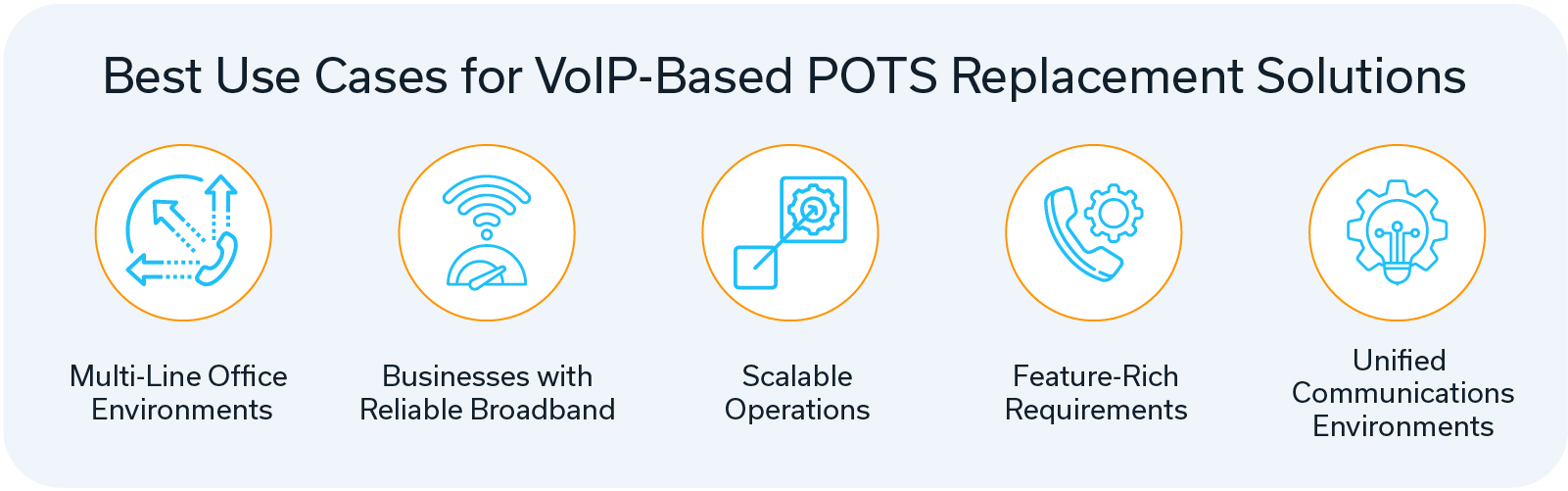
Best Use Cases for VoIP Replacement
VoIP excels in environments where flexibility, modern functionality, and scalability are priorities:
- Multi-Line Office Environments: Companies with numerous extensions or departmental phone lines benefit from centralized management and easier configuration.
- Businesses with Reliable Broadband: Consistent, high-speed internet can help support stable voice communication.
- Scalable Operations: Ideal for growing organizations needing additional lines or advanced phone features.
- Feature-Rich Requirements: VoIP supports voicemail-to-email, call routing, remote extensions, auto attendants, and more.
- Unified Communications Environments: Companies upgrading to cloud-hosted phone systems often integrate VoIP POTS replacement as part of a broader modernization effort.
Compared to cellular or fiber POTS replacement, VoIP supports more flexibility for traditional office communications and multi-line setups.
Key Features to Look For
Evaluating VoIP-based POTS solutions requires a different set of criteria compared to wireless or fiber services. Key features include:
- QoS (Quality of Service): Prioritizes voice traffic on your network to prevent jitter or call degradation.
- Power Backup Options: ATAs and gateways require electricity; reliable battery systems are essential for emergency and life-safety systems.
- Codec Support: High-quality codecs like G.711 can help ensure compatibility with analog endpoints and alarm systems.
- E911 Support: Emergency services must accurately map your address and location details.
- Compliance Certifications: Fire, elevator, and security systems may require certifications to meet local code requirements.
- Adequate Bandwidth: Sufficient upload/download capacity prevents congestion during peak usage.
Businesses should also verify that their POTS service providers offer monitoring tools and SLAs that support uptime and voice quality.
Pros and Cons of VoIP Solutions
As with any POTS replacement technology, VoIP has both strengths and limitations:
| Advantages: | Disadvantages: |
|
|
VoIP is ideal for organizations that already rely on broadband for daily operations and want to modernize their voice systems rather than simply replace legacy copper lines.
Fiber-Based POTS Replacement Solutions
Fiber-based POTS replacement solutions represent the most modern and infrastructure-stable alternative to copper-based telephone lines. As carriers continue shifting investments toward fiber, many organizations now have the option to support voice communications over a fiber-to-the-premises (FTTP) connection. This approach delivers exceptional reliability, low latency, and long-term flexibility, making it an attractive choice for facilities that want a future-proof system instead of a stopgap replacement.
While availability varies, fiber-based voice is rapidly becoming the standard offering from many major POTS service providers, especially in urban and suburban markets. When implemented correctly, fiber voice can support not only analog device connectivity, but also advanced communication services that scale with an organization’s growth.
How Fiber POTS Replacement Works
Fiber POTS replacement works by using a high-speed fiber optic connection delivered directly to the building. Instead of relying on copper, signals travel through optical fibers and are converted into usable voice service through the following components:
- Fiber-to-the-Premises (FTTP): A dedicated fiber line installed from the provider’s network to your building.
- Voice Services Over Fiber: Carriers deliver voice using digital VoIP technology, often wrapped in a “traditional line” interface for analog devices.
- Optical Network Terminal (ONT): A carrier-installed device that converts fiber signals into data, voice, or video outputs. ONTs typically offer RJ11 ports that mimic traditional POTS.
From the end user’s perspective, fiber voice can feel identical to a traditional analog line with far fewer failure points.
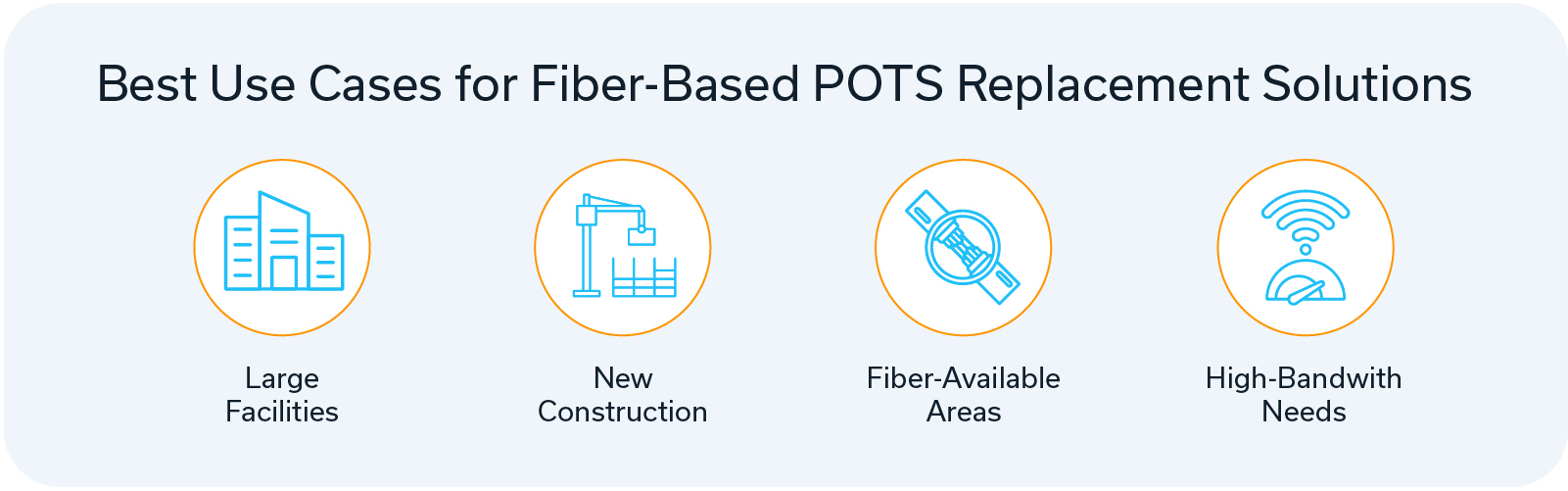
Best Use Cases for Fiber Solutions
Fiber-based POTS replacement is ideal for organizations with greater bandwidth requirements or those planning long-term infrastructure improvements:
- Large Facilities: Campuses, hospitals, or enterprise buildings where reliability and high throughput are essential.
- New Construction: Buildings designed with modern cabling and forward-looking telecom infrastructure.
- Fiber-Available Areas: Regions where carriers have fully deployed FTTP networks.
- High-Bandwidth Needs: Organizations with internet, voice, and data workloads that benefit from unified fiber delivery.
Because fiber is stable, insulated, and resistant to weathering, it is well-suited for mission-critical environments that demand continuous uptime.
Key Features to Look For
When evaluating fiber-based POTS replacement solutions, look for these core attributes:
- Carrier Availability: Not all areas have fiber access; coverage varies widely.
- Battery Backup at the ONT: Fiber requires power at the premises, and ONTs must support extended runtime for emergencies.
- Multi-Service Capability: Fiber can deliver voice, internet, and video over one connection.
- Reliability SLAs: Leading POTS service providers offer carrier-grade uptime guarantees for fiber-based voice.
Pros and Cons of Fiber Solutions
Selecting a provider with proven fiber deployment expertise is essential, especially for fire, elevator, and life-safety applications where downtime is not an option.
| Advantages: | Disadvantages: |
|
|
For organizations ready to invest in long-term telecom modernization, fiber-based solutions often represent the most strategic POTS replacement option.
What to Look for in a POTS Replacement Provider
As businesses transition away from copper-based lines, choosing the right partner becomes just as important as choosing the right technology. The quality, reliability, and compliance of your replacement solution depend heavily on the provider delivering it, and not all POTS service providers offer the same level of expertise or support. Understanding which providers offer reliable POTS line services can help you avoid costly downtime, compliance violations, and service interruptions that directly impact life-safety systems and critical infrastructure.
Selecting a provider is more than comparing prices. It’s about finding a partner who understands your environment, your regulatory obligations, and the operational pressures that come with replacing essential communication lines. Below are the attributes that truly separate top-tier providers from those that simply resell connectivity.
Experience and Track Record
Look for providers with a documented history of POTS replacement deployments across multiple industries. Providers who have completed hundreds or thousands of transitions are far better equipped to anticipate common pitfalls, integrate with legacy systems, and help ensure that fire alarms, elevators, security systems, and other devices function as expected after cutover.
Geographic Coverage and On-Site Capabilities
National or multi-regional coverage matters, especially for organizations with distributed locations. Providers should offer both remote and on-site support, with the ability to dispatch certified technicians when needed.
Critical systems don’t operate on a 9–5 schedule. Your provider should offer true around-the-clock support with trained technicians, not generic call-center staff reading from scripts.
Compliance Expertise
Fire alarms require UL certification. Fire alarm systems typically require UL-listed components and configurations. Elevators require ASME A17.1 compliance. Security systems must meet specific jurisdictional standards. Your provider should demonstrate explicit expertise in these compliance areas, not just general telecom knowledge.
Look for official credentials such as UL listings, manufacturer certifications, and carrier partnerships. These validate that the provider has met stringent technical and safety standards.
Installation, Monitoring & Maintenance
The best providers deliver an end-to-end service model, including equipment installation, configuration, remote monitoring, firmware updates, failover testing, and ongoing maintenance. Customer references and published case studies prove a provider’s ability to deliver results in real-world environments.
A trusted provider brings clarity, accountability, and long-term reliability, helping ensure your POTS replacement works exactly as intended when it matters most.
Cost Comparison of POTS Replacement Solutions
When selecting among different POTS replacement solutions, cost is often a leading concern, but the most inexpensive option upfront isn’t always the most economical over time. Below is a generalized comparison of cost factors across Cellular, VoIP, and Fiber-based POTS replacement solutions to help decision‑makers estimate total lifetime cost (TCO), ongoing fees, and potential hidden expenses.
Cost Comparison Overview
| Cost Factor/Solution Type | Cellular POTS | VoIP Replacement | Fiber Voice Service |
| Initial Equipment Cost | Low–Moderate (gateway + antenna + power supply) | Low (ATA or gateway) | Moderate–High (ONT installation, fiber drop) |
| Installation Cost | Low (simple install, minimal writing) | Low (uses existing network infrastructure) | Moderate–High (fiber termination, site prep) |
| Monthly Service Fees | Moderate (cellular data + voice service) | Low–Moderate (SIP trunk or hosted service) | Moderate (fiber lease + voice subscription) |
| Maintenance/Support | Low (minimal wiring, remote management) | Low–Moderate (network monitoring, ISP dependency) | Moderate (ONT maintenance, potential fiber repairs) |
| 5-Year Total Cost of Ownership | Low to Medium (predictable recurring costs) | Low (scales with usage, minimal upkeep) | Medium to High (higher initial & maintenance cost, stable over time) |
| Hidden Costs To Watch | Data overages, signal/coverage issues, battery replacement | Bandwidth outages, power backup for life-safety apps | Fiber availability, ONT power backup, installation lead times |
Note: Cost “Low / Moderate / High” is relative across solution types. Actual costs will vary by region, carrier, and deployment scope.
Ultimately, combining technical requirements, compliance demands, and financial forecasting will help you choose a solution that offers both affordability and long-term performance.
POTS Replacement Implementation Timeline and Processes
Implementing a POTS replacement solution requires careful planning, coordination, and testing to support minimal disruption to critical systems. Whether deploying Cellular, VoIP, or Fiber-based options, working closely with experienced POTS service providers promotes a smooth transition and reliable operation from day one.
Planning Phase
The process begins with a thorough assessment of your existing POTS-dependent systems.
Providers typically review:
- Number of lines and endpoints (fire alarms, elevators, security systems, etc.)
- Compliance requirements (UL, NFPA, ASME, local codes)
- Existing network infrastructure and power backup availability
- Site-specific constraints (remote locations, multi-building campuses)
This phase often takes 1–2 weeks, depending on system complexity and the number of locations.
Installation Duration
- Cellular POTS: Simple deployment; devices and antennas installed quickly, often within 1–3 days for small sites.
- VoIP POTS: Requires ATA or gateway configuration and network setup; typically 2–5 days including testing.
- Fiber-based POTS: Fiber termination, ONT installation, and site prep can take 1–3 weeks depending on provider scheduling and infrastructure availability.
Testing and Validation
All solutions require rigorous testing to verify:
- Call connectivity
- Emergency signaling functionality
- Power backup reliability
- Compliance with local safety codes
Testing helps ensure your systems remain operational during outages and that all endpoints are properly configured.
Cutover Considerations
Providers will plan a cutover schedule to minimize downtime, often performing the transition during off-peak hours. Multi-line systems may implement phased cutovers to maintain continuous service.
By partnering with reputable POTS service providers, organizations can streamline scheduling, maintain regulatory compliance, and achieve a reliable, seamless transition from legacy POTS lines to modern replacement solutions.
Common Mistakes to Avoid When Choosing POTS Replacement
Choosing the right POTS replacement solution is critical for maintaining business operations and compliance, yet many organizations make avoidable mistakes. Recognizing these pitfalls can save time, money, and prevent service disruptions.
Mistake 1: Not Assessing All POTS-Dependent Systems
Failing to inventory every device that relies on POTS (fire alarms, elevators, security systems, medical alert lines, etc.) can lead to unexpected outages. Always map out all endpoints before selecting a replacement.
Mistake 2: Choosing Based on Price Alone
While cost is important, the cheapest solution can lack redundancy, compliance certification, or sufficient support. Prioritize reliable POTS line services that meet performance and safety requirements.
Mistake 3: Ignoring Compliance Requirements
POTS replacements must comply with industry standards, including UL and NFPA for fire alarms or ASME for elevator phones. Overlooking regulations can result in code violations, fines, or insurance issues.
Mistake 4: Not Testing Adequately
Deploying a replacement solution without comprehensive testing can leave critical systems vulnerable. Test all endpoints, emergency functionality, and failover systems before going live.
Mistake 5: Waiting Until Forced by the Carrier
Delaying the transition increases the risk of downtime, rushed installations, and higher costs. Begin planning proactively rather than reacting to carrier phase-outs.
Mistake 6: Not Planning for Backup Power
Unlike traditional POTS lines, some replacements require external power. Ensure battery backup or alternative power options are in place to maintain service during outages.
Mistake 7: Overlooking Monitoring Capabilities
Monitoring tools provide alerts for line failures, connectivity issues, or low battery levels. Without them, problems may go undetected until a critical event occurs.
How to Avoid These Mistakes
- Conduct a full inventory of POTS-dependent systems.
- Evaluate providers based on reliability, compliance, and support, not just price.
- Confirm adherence to applicable codes and certifications.
- Schedule thorough testing for every endpoint.
- Develop a phased migration plan with backup power and monitoring in place.
- Partner with experienced providers who understand regulatory and operational requirements.
By addressing these common errors, organizations can ensure a smooth transition to reliable POTS replacement solutions, protecting critical systems and maintaining compliance.
Why Partner with Industrial Networking Solutions
When it comes to transitioning from legacy POTS lines to modern, compliant alternatives, partnering with a trusted provider is essential. INS offers unmatched expertise in delivering reliable POTS line services to businesses across industries, helping to ensure that critical systems like fire alarms, elevator phones, and security networks remain operational during and after migration.
INS Expertise and Experience
With decades of experience in telecommunications and network solutions, INS understands the intricacies of POTS replacement and the regulatory requirements that accompany it. We provide a full suite of POTS service provider solutions, including cellular, VoIP, and fiber-based replacements. This range allows businesses to choose the technology that best fits their operational needs, site conditions, and budget. We also offer hybrid configurations for organizations requiring multiple solution types across their facilities.
Nationwide Coverage and 24/7 Support
Whether your operations are concentrated in a single city or spread across the country, INS delivers consistent, high-quality service nationwide. Our dedicated support team is available around the clock to troubleshoot issues, provide guidance, and support uninterrupted connectivity.
Proven Track Record and Partnerships
INS has successfully completed POTS replacement projects for a diverse set of industries, including healthcare, commercial real estate, manufacturing, and municipal operations. Our longstanding partnerships with leading carriers and technology vendors provide clients with access to the latest solutions and consistently reliable service.
From multi-tenant office buildings upgrading fire alarm lines to industrial facilities modernizing emergency communications, INS consistently delivers smooth, compliant, and efficient POTS migrations. Our clients benefit from proactive planning, rapid deployment, and ongoing support tailored to their specific operational requirements.
Partnering with INS means choosing a trusted provider that prioritizes reliability, compliance, and peace of mind. For organizations seeking dependable POTS replacement services, INS is the partner that keeps your critical systems secure, operational, and future-ready.
Ready to Find the Right POTS Replacement Solution?
The phase-out of legacy POTS lines is happening now, and businesses cannot afford delays. Ensuring your fire alarms, elevator phones, and critical communication systems continue to operate requires a reliable, compliant, and future-proof replacement solution.
INS is here to guide you through every step of the process. Our team of certified technicians and POTS experts will assess your current infrastructure, recommend the most suitable replacement technology, whether cellular, VoIP, fiber, or a hybrid solution, and manage the migration from start to finish.
Schedule a free consultation or assessment today to:
- Identify all POTS-dependent systems in your facility
- Understand your compliance and safety requirements
- Explore solution options tailored to your needs
- Receive expert guidance on planning, installation, and ongoing support
Avoid disruptions and protect your operations. Partner with INS to maintain system continuity, meet regulatory demands, and prepare for future technology needs.