Why Industrial Infrastructure Is the Cornerstone of Modern Manufacturing
Joel Albert, Vice President of Sales for Industrial Technologies at INS | December 18, 2025
If you look at the pace of change in manufacturing, it is obvious the next decade will not look like the last one. Plants are becoming more connected. Machines are producing more data. Mobility is becoming a core part of operations. AI is moving from buzzword to tool. And the number of intelligent devices on the plant floor continues to rise.
All of that sounds exciting, but it creates a simple, unavoidable truth: none of it works without the right industrial infrastructure underneath it.
Not IT infrastructure placed in a cabinet. Not traditional switches tucked into an enclosure. What modern manufacturing needs is purpose-built industrial networking designed for machines, timing, visibility, and nonstop production.
I have spent my entire career in environments where that reality shows up every day. If the infrastructure is not ready, nothing else has a chance.
My Background: Raised in Manufacturing, Trained in Engineering
My relationship with this industry started early. I grew up around manufacturing and was walking plant floors with my dad before I understood what most of the equipment even did. Later, at Texas A&M, I studied electrical engineering and knew I wanted to work in industrial environments.
My career has taken me through almost every layer of the manufacturing stack. I supported automation systems for a distributor with major industrial accounts, led engineering teams, worked as a senior electrical engineer, and later focused on MES, industrial IT, Cisco IoT, and secure automation architectures.
That mix of automation, controls, IT, software, and engineering leadership shaped how I see industrial networks. I do not view them as IT systems. I see them as part of the manufacturing process itself.
Industrial Networking Is Its Own Discipline
There is a common misconception that industrial networking is just IT equipment ruggedized for the plant floor. In practice, the requirements are completely different.
IT networks are built around users, applications, and cloud workloads. Industrial networks are built around machines, timing, and deterministic behavior. They carry the traffic that drives production: PLC commands, motion systems, batching processes, recipe execution, vision systems, safety circuits, connected workers, and mobile automation like AGVs and AMRs.
Machines cannot pause or buffer the way IT systems can. If a video call drops, it is an inconvenience. If a motion system loses packets, the process stops. Industrial networking is a discipline built around the performance and safety requirements of manufacturing.
Data Growth Is Redefining What Plants Need
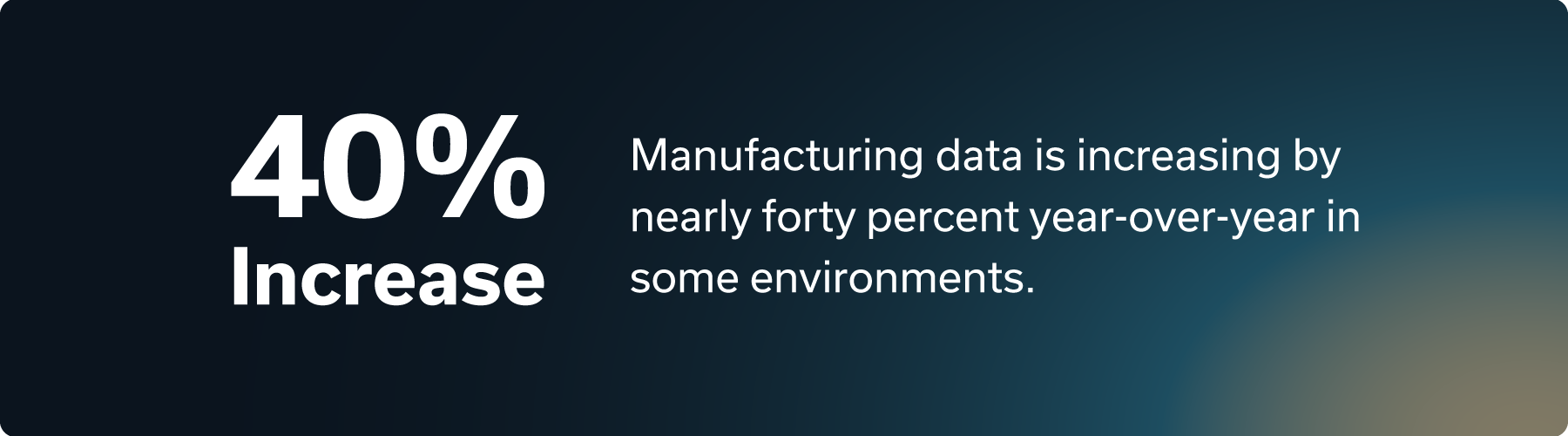
One of the most dramatic shifts happening right now is the amount of data produced by machines. Industry research and frontline experience both show that manufacturing data is increasing by nearly forty percent year-over-year in some environments.
That growth does not just come from sensors. It comes from:
- Higher-resolution vision systems
- More mobile workflows
- Business system and supply chain system integration
- Real-time quality assurance
- Smarter equipment
- More edge computing
- AI executing close to the process
- Increased demand for real-time visibility
Most machines already act as intelligent edge devices. What limits plants is not the equipment. It is the infrastructure that has to move and manage all of this data.
If the network cannot handle it, modernization stalls before it begins.
Why INS Services Always Start With Assessment
When a customer begins a modernization project, it is tempting to focus on the new technology they want to introduce. But you cannot build a future-state architecture until you understand the current state of the system.
This is why INS strongly encourages infrastructure assessments before design begins. An assessment reveals:
- How machines are communicating
- Whether the network behavior is deterministic or unpredictable
- Where performance bottlenecks exist
- Which parts of the environment introduce risk
- What equipment can be reused
- How ready the system is for the data growth ahead
I have seen customers overspend because they did not know which parts of their environment were still solid. I have also seen customers underbuild because they did not realize how much load was coming.
Understanding the current architecture is the first step toward building one that will last.
Real Examples of What Strong Infrastructure Enables
One manufacturer deployed equipment that technically worked, but it did not meet the certifications required in their environment. Because no one had reviewed the architecture and requirements beforehand, the entire deployment had to be replaced. That situation was preventable with proper assessment.
Another company expected a network modernization to take several years because of the scale of their assets. Once we understood the operational requirements, machine behavior, and data flows, we redesigned the architecture, validated the approach in a controlled environment, and significantly reduced the timeline. The result was a stronger system implemented much faster than they expected.
In both cases, the breakthrough did not come from a specific product. It came from clarity.
Industrial and IT Networks Serve Different Purposes
Modern manufacturers need both industrial and IT systems, but the two environments are not interchangeable.
IT networks are built for users and broad data movement. Industrial networks are built for machines and predictable timing. As manufacturing becomes more connected and more dependent on data, these worlds overlap more than ever, which creates both complexity and opportunity.
This overlap is where INS spends much of its time. We understand industrial protocols, automation timing, machine behavior, and OT workflows, and we pair that with the security, connectivity, and scalability expectations that come from the IT world. Helping customers integrate these environments in a controlled and reliable way is central to what we do.

Where Manufacturing Is Heading
Across all industries, manufacturing is moving toward more automation, more data, more connected workers, more edge intelligence, and more distributed operations. AI is beginning to influence both real-time decision-making and long-range planning. Plants are becoming more mobile and more flexible.
Private cellular is becoming an important part of that shift. It supports the reliability, coverage, and mobility required for environments with high device density or complex workflows.
These trends are accelerating quickly. Infrastructure can no longer be static. It must be designed with the next several years in mind.
What I Tell Customers Preparing for Modernization
Upgrading a plant is not about choosing hardware. It is about designing a system that supports the capabilities you expect your operation to have in the next three to five years.
- Start with your machines.
- Understand your workflows.
- Understand your data needs.
Then build infrastructure that supports that direction. When you approach modernization this way, the path becomes clearer and the results last longer.
INS helps customers take that structured, practical approach. It is how industrial transformation succeeds.
Final Thought: Bring Us the Challenge, Not the Part Number
 |
If there is one thing I hope manufacturers remember, it is this: tell INS the challenge; do not start with the product list. Manufacturing is evolving quickly. Your network needs to be ready for what is coming next. |