
Why POTS Lines Are Going Away
January 28, 2026
What Businesses Need to Know
As telecom carriers accelerate the discontinuation of legacy copper networks, POTS lines are going away faster than many businesses realize. Organizations that rely on Plain Old Telephone Service for fire alarm monitoring, elevator emergency phones, security systems, or other critical communications face increasing risk if they don’t act proactively. POTS lines, once the backbone of business and public safety communications, are being phased out in favor of digital, fiber, and cellular alternatives that offer more flexibility and modern capabilities.
Learn More About POTS Replacement Solutions
For business owners, facility managers, and IT professionals, understanding the POTS phase-out is essential. This guide will explain why carriers are retiring POTS, outline the regulatory role of the FCC, detail the phase-out timeline, and highlight how the change impacts critical systems. By the end, you’ll know what steps to take to protect your operations, maintain compliance, and plan for a seamless transition to modern telecommunication solutions.
The POTS Phase-Out: A Brief History
The story of POTS lines going away begins with their heyday in the 1990s and early 2000s, when Plain Old Telephone Service formed the backbone of communication for homes and businesses alike. During this period, virtually every business relied on copper-based analog lines for voice service, and critical systems such as fire alarms, elevators, and security panels were designed to work exclusively over POTS.
As technology advanced, however, alternative communication systems began to emerge. Digital phone systems, Voice over IP (VoIP), and fiber-based networks offered faster, more scalable, and feature-rich options. Businesses recognized the benefits of transitioning to these new technologies, particularly for multi-line environments, integrated communication systems, and cost reduction.
Economic pressures also contributed to the decline of POTS. Maintaining aging copper infrastructure has become increasingly costly for carriers, especially as the number of active POTS subscribers dwindled. Technicians familiar with copper networks are becoming scarce, and replacement parts for legacy equipment are harder to source. This shift in carrier economics, combined with growing demand for broadband and digital services, has driven the industry toward modern networks.
Industry trends reflect this transition. Regulators, carriers, and businesses alike are moving toward digital-first solutions, and the phase-out of POTS lines is accelerating. While POTS once represented the pinnacle of reliable communication, the combination of technological progress, economic reality, and customer expectations has set the stage for its retirement. Businesses that rely on POTS today must be aware of these shifts to plan their migration effectively and
ensure that critical systems remain operational.

FCC POTS Retirement Regulations
The decline of POTS isn’t just market‑driven. It’s now backed by regulatory changes that actively allow and even accelerate the retirement of copper‑based telephone infrastructure.
The Role of the Federal Communications Commission (FCC)
As the federal regulator of telecom infrastructure, the FCC sets rules governing when and how carriers can retire legacy copper networks. Historically, carriers offering copper‑loop (POTS) services faced obligations to maintain analog network access, especially for wholesale providers and competitive services.
In recent years, the FCC has systematically loosened these constraints, clearing the way for nationwide retirement of copper‑based services, including POTS and legacy TDM (time-division multiplexed) voice.
Key Orders & Regulatory Changes
- The watershed change came with FCC Order 19-72 (2019), which removed price caps and other regulatory burdens that had kept copper‑based services artificially sustained.
- Under Order 19-72, carriers gained flexibility to phase out POTS without maintaining discounted legacy rates. This effectively signals that providers are no longer obligated to offer copper‑based voice as a regulated service.
- Further accelerating the transition, in March 2025 the FCC adopted additional rule changes designed to “streamline” copper retirement. Among the changes: reduced notice periods for customers (from 180 days to 90 days), and relaxed requirements for providing a standalone voice service once copper is retired.
These regulatory updates mean that carriers may now retire legacy infrastructure more rapidly and with far less advance warning than in the past, while remaining compliant with FCC rules, as long as they provide required notice.
From Legacy Service to Copper Decommissioning
With the regulatory framework changed, many carriers have begun treating POTS (and all copper‑based telephone services) as “legacy” offerings. That shift effectively means:
- No new copper‑based line installs, moves, or changes in many areas
- Accelerated retirement of copper loops and switch‑based voice infrastructure in wire centers across the country
- Price increases or service discontinuation notices for remaining customers, particularly those with legacy lines
In short: regulatory support for copper retirement, combined with carrier economics and infrastructure challenges, has created a turning point. For many businesses and facilities still relying on POTS, this means the time to plan a transition is now, before service becomes unreliable, cost‑prohibitive, or legally non-compliant.
Explore POTS Replacement Solutions
Why Telecom Carriers Are Phasing Out POTS
The phase-out of POTS lines is driven by a combination of economic, technological, and strategic business factors. Understanding these drivers helps businesses anticipate the impact and plan for reliable replacements.
Economic Factors
Maintaining legacy copper infrastructure has become increasingly costly for telecom carriers. Aging copper loops require regular inspection, repair, and replacement due to corrosion, physical damage, and environmental wear. The shrinking POTS customer base further compounds the problem; fewer subscribers mean that the return on investment for maintaining the copper network continues to decline.
Additionally, copper network maintenance demands specialized technician skills. Experienced line technicians are becoming harder to find, and training new personnel to service outdated systems is both time-consuming and expensive. As a result, carriers face rising operational costs for a service that is no longer profitable compared to modern alternatives.
Technology Factors
Copper networks themselves are reaching the limits of reliability. Components such as electromechanical switches, distribution frames, and cross-connects are often decades old, and replacement parts are increasingly difficult to source. Signal quality degradation, higher susceptibility to interference, and limitations on bandwidth make copper less suitable for contemporary communication needs.
Modern alternatives, including fiber-optic and wireless networks, provide superior reliability, higher speeds, and lower long-term maintenance requirements. These technologies support both voice and data services on a single platform, reducing complexity and improving network efficiency. As a result, carriers see diminishing justification to maintain separate, analog copper infrastructure.
Business Factors
From a strategic perspective, carriers are prioritizing investments in fiber and wireless networks. Fiber-to-the-home (FTTH) and LTE/5G networks deliver greater scalability, more features, and higher margins than POTS, aligning with the long-term business goals of telecom providers.
Spectrum management and right-of-way considerations also play a role. By decommissioning copper lines, carriers free up physical and spectral resources for high-bandwidth services that meet modern consumer and enterprise demand. This shift allows telecom companies to repurpose resources toward services that drive growth, such as broadband internet, VoIP, and cellular voice services.
Ultimately, the decision to phase out POTS is a calculated one: the economic burden of maintaining outdated infrastructure, coupled with technological limitations and evolving business priorities, has made POTS lines increasingly unsustainable. Businesses that continue to rely on POTS must now plan for replacements to avoid service disruptions, compliance issues, or rising costs.
POTS Phase-Out Timeline: What to Expect
The retirement of POTS lines is happening in stages, influenced by carrier-specific plans and regulatory oversight from the FCC. While the timeline varies by region, understanding the historical context and current status helps businesses anticipate and plan for this transition.
The move to phase out POTS began as early as the 2010s. Major carriers like AT&T, Verizon, and CenturyLink announced gradual retirement schedules for their copper networks, citing declining subscriber numbers and rising maintenance costs. Initial phase-out efforts focused on small or rural exchanges where digital alternatives were already deployed. By 2015-2017, several states saw pilot programs replacing analog POTS lines with digital or VoIP-based solutions, signaling the start of a nationwide trend.
As of 2025, the POTS phase-out is accelerating. Many urban areas now rely primarily on fiber and wireless networks, and copper lines are increasingly limited to legacy or critical systems. Geographic and use case variations remain significant:
- Urban centers: POTS availability is declining rapidly, with most carriers actively transitioning customers to fiber or VoIP
- Suburban and rural areas: Copper lines still exist in some regions, but carriers have begun notifying customers of upcoming discontinuation
- Critical systems: Fire alarms, elevator phones, and other life-safety applications are receiving special attention enforced by local authorities, with carriers often providing extended support or alternative solutions until certified replacements are installed
Carriers project that the complete phase-out of POTS lines will occur over the next decade, with final discontinuation dates varying by company and region. Exceptions and special cases may exist where POTS lines remain operational due to regulatory requirements, technical constraints, or contractual obligations. Businesses should confirm timelines with their service providers to avoid service interruptions.
Impact on Critical Systems and Life Safety Equipment
The phase-out of POTS lines presents significant implications for businesses and facilities that rely on legacy analog connections for critical systems. As carriers retire copper infrastructure, any device or service dependent on a POTS line is at risk of losing connectivity, which can directly impact safety, compliance, and operational continuity.
Fire Alarm Monitoring Systems
Many fire alarm panels are configured to transmit signals over POTS lines to central monitoring stations. With POTS lines going away, these systems may fail to report alarms or system faults unless an alternative connection is installed. Failure to maintain proper monitoring can put lives at risk and potentially violate local fire codes, creating liability for property owners and managers.
Elevator Emergency Phones
Elevator emergency communication systems often rely on POTS lines to connect passengers to emergency responders. National safety standards enforced by elevator authorities, including ASME A17.1, specify reliable voice communication. Discontinuation of POTS without replacement risks making elevators non-compliant, potentially leading to fines or operational shutdowns until a certified replacement is installed.
Security Systems and Other Critical Devices
Beyond alarms and elevators, several other systems depend on analog phone lines:
- Emergency call boxes on campuses or public areas
- Medical alert and emergency response systems
- Point-of-sale terminals in retail environments
- Building access control and surveillance alarms
All of these systems may lose connectivity if POTS lines are decommissioned, putting safety, financial, and operational systems at risk. Businesses and building owners must proactively assess which systems rely on POTS and implement suitable alternatives before service discontinuation occurs. Waiting until carriers forcibly retire lines can result in unplanned outages, emergency service interruptions, and costly last-minute solutions. By planning early, organizations can ensure continuity of service, regulatory compliance, and the safety of occupants.
What Happens If You Don’t Replace POTS Lines?
As POTS lines are increasingly phased out, businesses that delay upgrading their systems face a range of operational, financial, and compliance risks. POTS lines have long been the backbone for critical communications, but with carriers retiring analog copper infrastructure, relying on them can leave organizations vulnerable.
Service Discontinuation Risks
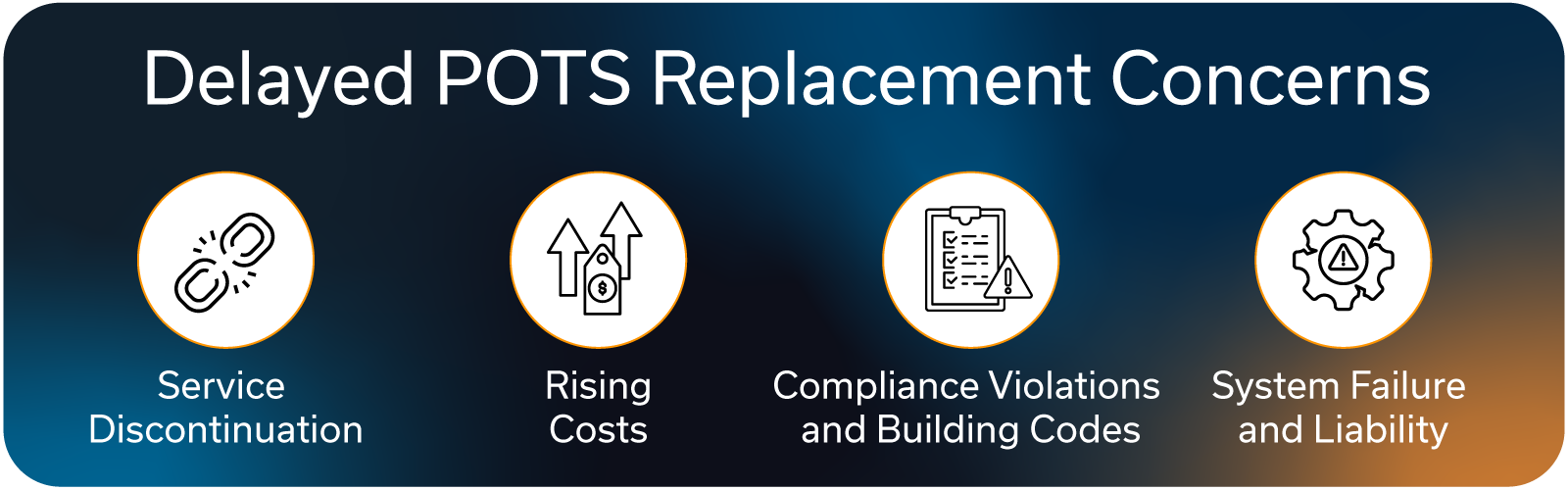
The most immediate consequence of inaction is a complete loss of service. If a carrier decommissions your POTS lines, devices that depend on them—fire alarms, elevator phones, security systems, and even point-of-sale terminals—may stop functioning. This can interrupt business operations and compromise safety.
Rising Costs for Remaining POTS
As fewer customers use POTS, carriers are increasing the cost of maintaining the remaining lines. Businesses that continue to rely on analog connections may face higher monthly fees, surcharges for service calls, and escalating maintenance costs.
Compliance Violations and Building Codes
Many life-safety systems, including fire alarms and elevator emergency communications, are required by applicable codes and regulations to maintain reliable connectivity. If POTS lines are no longer active and replacements are not in place, organizations risk violating fire codes, building codes, and industry regulations. Such violations may result in fines, delays in occupancy, or enforcement actions depending on local code requirements.
System Failure and Liability
Critical system failures could pose safety risks and lead to potential liability for property owners or managers. Insurance policies often require that systems be maintained in compliance with regulations. Inactive or unreliable POTS lines could compromise coverage and create legal exposure in the event of an incident.
Waiting until POTS lines are forcibly removed leaves no room for planning or testing replacement solutions. Proactive migration ensures continuity, compliance, and safety while minimizing costs and operational disruption.
Your Options When POTS Lines Go Away
As POTS lines going away becomes an increasing reality, businesses need to proactively explore replacement solutions to maintain connectivity for critical systems and daily operations. Fortunately, several viable alternatives exist, each with its own strengths and ideal use cases.
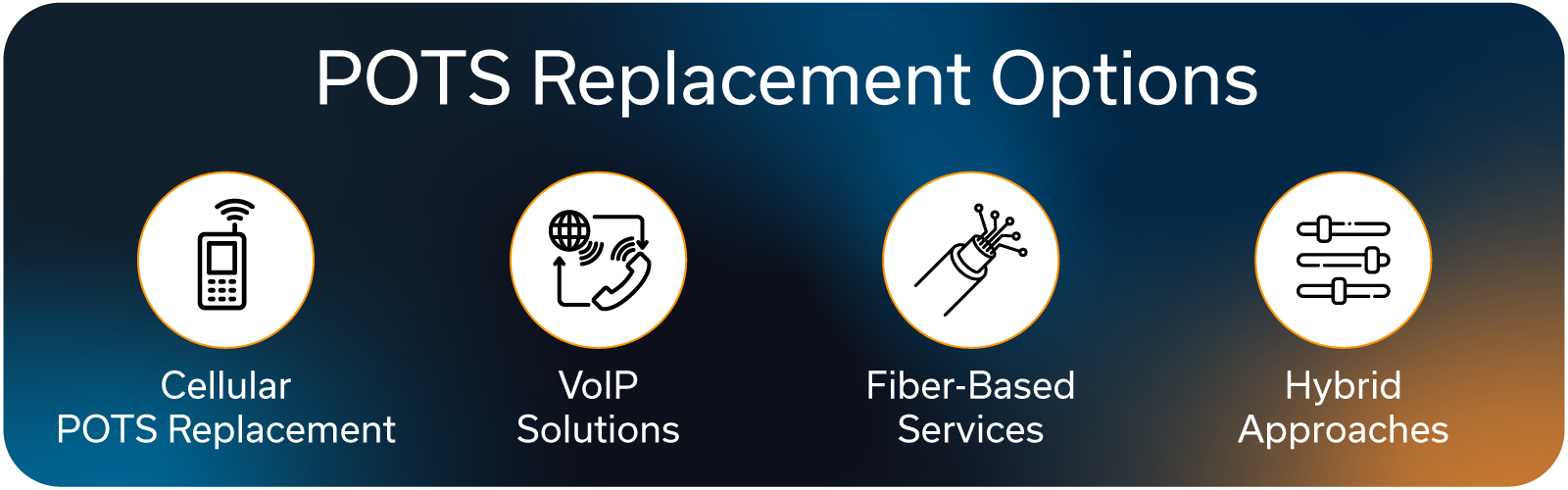
Cellular POTS Replacement
Cellular-based solutions emulate traditional POTS functionality using LTE or 5G networks. These systems are especially effective for fire alarms, elevator phones, and remote locations where running new wiring is difficult or cost-prohibitive. INS implements purpose-built cellular POTS replacement platforms designed to support life-safety and compliance-driven analog devices. These solutions offer battery backup, simple installation, remote monitoring, and continued operation during power outages, making them a reliable option as copper networks are retired.
VoIP Solutions
Voice over Internet Protocol (VoIP) leverages existing internet connections to deliver voice services for everyday business communications. VoIP is highly scalable and cost-effective, with advanced features such as call forwarding, voicemail-to-email, auto attendants, and mobile device integration. It is best suited for office environments, while legacy analog or life-safety systems are often supported more effectively with dedicated POTS replacement solutions. Because VoIP depends on local power and the internet, it is generally separated from critical systems to reduce risk.
Fiber-Based Services
Fiber-to-the-premises (FTTP) provides high bandwidth and long-term infrastructure for voice and data applications, particularly in new construction or campus-style environments. While fiber supports modern IP communications, it generally does not replicate POTS functionality without additional technologies. As a result, fiber is often part of a broader network modernization strategy rather than a standalone POTS alternative.
Hybrid Approaches
Many organizations find value in combining technologies to meet unique requirements. A hybrid strategy often includes cellular POTS replacement for elevators, fire alarms, and security systems, paired with VoIP or IP-based services for office communications. This approach is designed to support modern features, redundancy, and compliance while minimizing disruption to critical systems.
Waiting until carriers force disconnection can disrupt operations and create compliance risks. Businesses should inventory POTS-dependent systems, evaluate replacement options, and implement solutions ahead of retirement timelines. For a detailed walkthrough of migration strategies, costs, and best practices, see our complete guide to POTS line replacement options.
Taking Action: Steps to Prepare for POTS Phase-Out
With POTS lines going away, businesses can no longer rely on traditional analog phone lines for critical operations. Proactive preparation is essential to ensure continuity, compliance, and minimal disruption. Taking action now can save time, reduce costs, and prevent emergencies later.
Step 1: Inventory All POTS-Dependent Systems
Begin by identifying every system that relies on POTS lines, from office phones to fire alarms, elevator phones, security systems, point-of-sale terminals, and medical alert devices. Document each line, its purpose, and its connection type. A comprehensive inventory forms the foundation for a smooth transition.
Step 2: Check with Your Current Carrier About Timelines
Reach out to your telecom provider to understand when POTS retirement will impact your service. Carrier notifications can vary by region, so confirm dates for disconnection, available alternatives, and any special provisions for critical systems.
Step 3: Assess Replacement Options
Evaluate available technologies, including cellular POTS replacements, VoIP, fiber services, and hybrid solutions. Consider factors such as reliability, scalability, cost, and compliance requirements for life-safety systems. A clear comparison helps guide the most suitable choice for your organization.
Step 4: Verify Compliance Requirements
Ensure that replacement options meet regulatory standards for fire alarms, elevator emergency phones, and other critical systems. Understanding local and federal requirements reduces liability and maintains safety compliance.
Step 5: Create a Migration Plan
Develop a step-by-step plan detailing assessment, vendor selection, installation, testing, and cutover procedures. Include timelines, responsibilities, and contingencies for unexpected challenges.
Step 6: Budget for Replacement
Allocate sufficient funds for equipment, installation, service fees, and ongoing maintenance. Early budgeting helps avoid last-minute financial strain and allows for strategic decision-making.
Step 7: Partner with an Experienced Provider
Working with a knowledgeable POTS replacement provider ensures that the transition is efficient, compliant, and reliable. Experienced partners can offer guidance, project management, and support through every stage.
To get started, explore our POTS Replacement Solutions.
Plan Your POTS Replacement Now
The phase-out of POTS isn’t theoretical or optional. It’s happening now, and businesses that rely on analog lines for life-safety systems, communications, and critical infrastructure cannot afford to wait. As carriers retire copper networks and discontinue legacy services, every organization must have a clear, proactive plan to protect operations and maintain compliance.
INS has helped thousands of businesses navigate the transition away from POTS with reliable, code-compliant, and cost-effective modern solutions. Our team specializes in evaluating existing systems, identifying risks, and designing replacements that preserve functionality without disrupting daily operations. Whether you’re supporting a single fire alarm panel or dozens of distributed facilities, we make the migration predictable, transparent, and future-proof.
If you haven’t begun planning, or if you’re unsure where to start, now is the time to connect with a trusted partner. INS can perform a detailed review of your current POTS footprint and outline the most efficient path forward.
Get your evaluation started today with a POTS replacement assessment.